

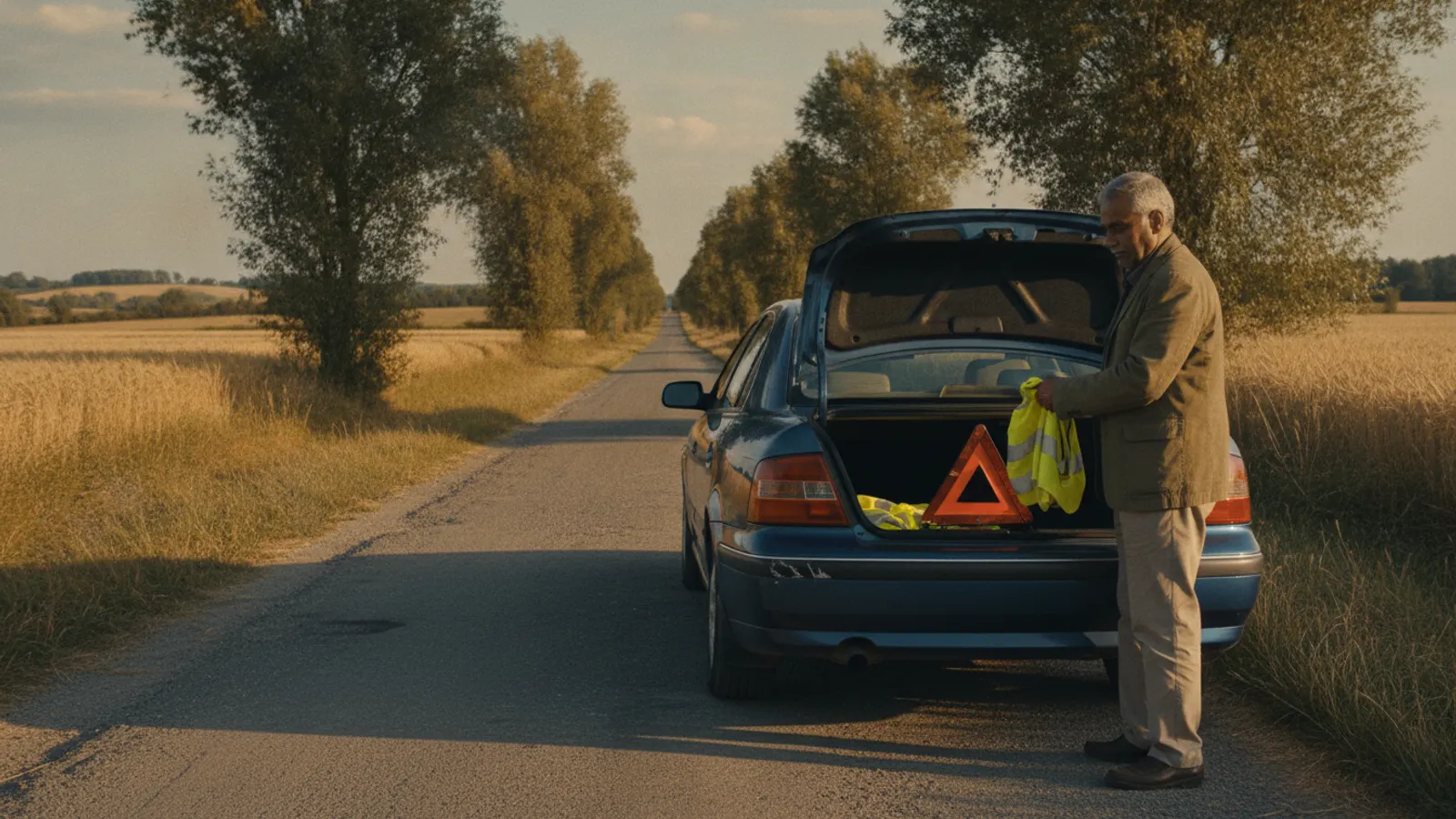
When the car stops: the kit, and the order to use it in
One ordinary breakdown walked through in order — where you stop, what goes out behind you, when to get out and when not to, and which object each step turns out to need.
A breakdown is not a crash and does not announce itself as an emergency. Something changes — a noise, a warning lamp, a loss of power, a tyre going soft — and there is a short window in which the driver is still deciding whether it is serious. Almost everything that later matters is settled inside that window, and almost none of it is settled by knowing anything about engines.
So this piece walks one ordinary breakdown through in order, naming at each step the object the step turns out to need. The breakdown is a genre rather than an event: no road in it, no hour, no make of car, no sum of money and no insurer, because inventing those would make it vivid and make it less true. What is specific is the published instruction at each step.
The decision you make at full capacity is where you stop
The first instruction in the United Kingdom’s Highway Code is not about equipment. If your vehicle breaks down, it says, think first of all other road users — and then, first bullet, get your vehicle off the road if possible. It spends a whole rule defining the standard: a place of relative safety is where you, your passengers and your vehicle are less likely to be at risk from moving traffic.
Relative is doing the work there. On a fast road there is no safe place to stop, only places that are less bad, and the difference is chosen in the first seconds, while the car still has momentum and the driver still has a working head. The motorway rule sequences it: move into the left lane, and pull into an emergency area or onto a hard shoulder if you can.
The second instruction is the one drivers actually do first, and it costs nothing — warn other traffic by using your hazard warning lights if your vehicle is causing an obstruction. The commercial version of the same rule has an endpoint attached: a driver whose vehicle is stopped on the travelled portion or the shoulder of a highway shall immediately activate the hazard warning signal flashers and continue the flashing until the warning devices are placed. Hazard lights are not a solution. They are a placeholder for a device that is not out yet.
What goes out behind you, and the country that abolished it
The Highway Code still describes the triangle: put a warning triangle on the road at least 45 metres behind your broken-down vehicle on the same side of the road, or use other permitted warning devices if you have them. Then come the two clauses that carry most of the danger — always take great care when placing or retrieving them, and never use them on motorways. A triangle protects the vehicle by sending a person forty-five metres up the carriageway on foot, and back again.
Spain has resolved that tension by removing the object. Its traffic authority states that the connected V16 is the only legal pre-signalling device from 1 January 2026, replacing the traditional triangles, which had already stopped being obligatory on motorways and dual carriageways from 1 July 2023. The royal decree behind it defines the V-16 as signalling that the vehicle has been immobilised on the carriageway or that its load has fallen on it: yellow, on the highest possible part of the vehicle, covering 360 degrees horizontally, communicating its activation, deactivation and geopositioning to the national traffic access point every hundred seconds, and depending on nothing outside its own casing, not even a telephone application. The DGT adds the operational consequence, which is the whole argument: it can be put in place without getting out of the vehicle.
The United States splits along a different line. For commercial vehicles the rule is federal: within ten minutes of stopping the driver places warning devices in a prescribed pattern, set further out where a hill, a curve or an obstruction hides the vehicle. What counts as a device is specified too — three bidirectional emergency reflective triangles meeting the federal standard, or at least six fusees or three liquid-burning flares. For an ordinary car there is no federal equivalent and the requirement is a state matter, and the state instruments are narrower than they look: California’s asks three red emergency reflectors of the vehicles it covers, and prescribes their placement only for a vehicle disabled on the roadway during darkness.
Getting out is the instruction, and it is the one people argue with
The Highway Code’s motorway rule is a sequence of imperatives that runs against the instinct that a car is shelter. Exit your vehicle by the side furthest from traffic, if it is safe and possible to do so. Wait well away from your vehicle and moving traffic, behind the safety barrier. Use the free emergency telephone to obtain advice and assistance. Animals must be kept in the vehicle or, in an emergency, under control on the verge. And then the sentence that tells you what the rule is really about: do not return to your vehicle even if it is raining, cold or dark.
National Highways states the exception with the same flatness: where leaving is not safe, stay in the vehicle with seatbelts and hazard warning lights on, and call 999. Spain’s rule is the mirror image of the same logic, quoted by the DGT from the traffic regulations — the occupants must leave the vehicle whenever there is a safe place off the carriageway, and where conditions do not permit a safe exit they remain in the cabin with seat belts fastened.
So the decision is not inside or outside. It is can I get out on the far side and get past the barrier — and where the answer is no, the seat belt goes back on, which is the opposite of what waiting feels like.
The unlit road, where the published advice thins out
Motorway guidance is abundant because motorway breakdowns are counted. A rural road at night is a different problem and the instructions are sparser. The Highway Code’s general breakdown rule carries three lines that belong to the dark: wear light-coloured or fluorescent clothing in daylight and reflective clothing at night or in poor visibility; keep your sidelights on if it is dark or visibility is poor; and do not stand, or let anybody else stand, between your vehicle and oncoming traffic, or where you block other road users’ view of your lights.
None of them addresses what a rural breakdown actually produces — an unlit verge, a hedge or a ditch where the barrier should be, possibly no signal. The barrier instruction assumes a barrier; the emergency-telephone instruction assumes a motorway. That is a gap in the published guidance rather than an omission here, and the only defensible way to fill it is with the part of the motorway answer that travels.
The kit, assembled backwards
Work through that sequence and the contents choose themselves. The hazard switch and the lamps are already there, which is why the habit that matters most before a long drive is the one that checks they all work. The pre-signalling device is whatever the market requires — a triangle where triangles are still permitted, a certified connected beacon in Spain, both in a car that crosses that border — and it belongs within reach of the driver’s seat rather than in the boot under the luggage, because the entire published case for the beacon is that it is deployed without getting out.
The clothing has an instruction behind it, fluorescent by day and reflective by night, and a jacket behind the spare wheel is not reachable from the door you are being told to leave by. The Code assumes you will be outside for a long time and says so by anticipating rain, cold and dark, which makes a warm layer within reach a sourced item rather than a comfort. An animal needs a lead before the door opens. And the phone is the emergency telephone everywhere except the motorway, which means it needs charge — the one thing here decided hours earlier.
Nothing else is anchored to a published instruction, and the honest thing is to say so. A torch, water, a blanket, and a high-visibility vest per seat rather than one for the driver are all reasonable, and none of them appears in the sources this piece was built from.
A vehicle that belongs to somebody else
A company driver has the same problem plus two more: the vehicle is not theirs, and somebody at a desk needs to know before the customer does. The United States federal rule lists what a commercial power unit carries — a fire extinguisher, spare fuses, and the warning devices described above — and requires every one of them in the vehicle. That is the clause that fails in practice: a depot inventory proving the company owns triangles is not compliance, and a vest in a supervisor’s office is a vest nobody is wearing on a verge.
When the breakdown becomes a collision
Sometimes the car stops and something hits it. A stationary vehicle on a carriageway is an obstruction rather than a participant, and the question that follows is always what was done to mark it and how long it stayed unmarked.
What a file is later argued from is the record of exactly that. Whether the hazard lights were on, and from when. Whether a device was out, of what kind, and where. Where the vehicle had been stopped, and where the occupants were. When the call was made, and to whom. None of that decides blame, and this piece will not tell you how an insurer or a court weighs it, because that answer is fact-specific and not ours to give. What can be said is structural: those are the things nobody can reconstruct afterwards, and several are timestamped automatically where a connected device or an emergency call was involved. Whether a dispute about the resulting file — about cover, or about the way the claim was handled — can be taken past the insurer is a question for the insurance supervisor named in the data below.
What we cannot tell you
We cannot tell you whether you will be safer inside or outside your car on a particular verge on a particular night: the published rules are written for the roads that get counted, and they thin out where the decision becomes hard. We cannot tell you what device your own country requires of you today, only that the answer moved recently and may move again. And we cannot tell you that any of this protects you from a vehicle that is not looking, which is the failure mode the whole sequence is built around and the one nothing in the boot solves.
The part that is decided before anything happens
Everything above is a series of small actions taken by somebody who has just had a fright and is standing in the wrong place. Not one of them requires skill. All of them require the object to be reachable from the seat that person is sitting in, and the sequence to have been read once, in a chair, by someone who was calm.
A beacon in the boot is not a beacon. It is a reason to walk round the car.
Rules in your jurisdiction
Deadlines, fault rules and minimum coverage differ by state and country. Pick yours to see the rules that apply to this topic.
Select a jurisdiction to see its rules.
| Regulator | Alabama Department of Insurance |
|---|
Verified as ofSeptember 15, 2026 · Car insurance claims in Alabama →
| Regulator | Alaska Division of Insurance, Department of Commerce, Community, and Economic Development |
|---|
Verified as ofSeptember 11, 2026 · Car insurance claims in Alaska →
| Regulator | Government of Alberta — automobile insurance |
|---|
Verified as ofSeptember 10, 2026 · Car insurance claims in Alberta →
| Regulator | Superintendencia de Seguros de la Nación (SSN) |
|---|
Verified as ofSeptember 10, 2026 · Car insurance claims in Argentina →
| Regulator | Arizona Department of Insurance and Financial Institutions (DIFI) |
|---|
Verified as ofSeptember 10, 2026 · Car insurance claims in Arizona →
| Regulator | BC Financial Services Authority (BCFSA) |
|---|
Verified as ofSeptember 10, 2026 · Car insurance claims in British Columbia →
| Regulator | California Department of Insurance |
|---|
Verified as ofSeptember 10, 2026 · Car insurance claims in California →
| Regulator | Comisión para el Mercado Financiero (CMF) |
|---|
Verified as ofSeptember 10, 2026 · Car insurance claims in Chile →
| Regulator | Superintendencia Financiera de Colombia |
|---|
Verified as ofSeptember 10, 2026 · Car insurance claims in Colombia →
| Regulator | Colorado Division of Insurance |
|---|
Verified as ofSeptember 11, 2026 · Car insurance claims in Colorado →
| Regulator | Connecticut Insurance Department |
|---|
Verified as ofSeptember 11, 2026 · Car insurance claims in Connecticut →
| Regulator | Delaware Department of Insurance |
|---|
Verified as ofSeptember 11, 2026 · Car insurance claims in Delaware →
| Regulator | District of Columbia Department of Insurance, Securities and Banking |
|---|
Verified as ofSeptember 15, 2026 · Car insurance claims in District of Columbia →
| Regulator | Superintendencia de Seguros de la República Dominicana |
|---|
Verified as ofSeptember 10, 2026 · Car insurance claims in Dominican Republic →
| Regulator | Financial Conduct Authority (conduct) · Financial Ombudsman Service (complaints) |
|---|
Verified as ofSeptember 10, 2026 · Car insurance claims in England and Wales →
| Regulator | Florida Office of Insurance Regulation (regulation) · Department of Financial Services, Division of Consumer Services (complaints) |
|---|
Verified as ofSeptember 10, 2026 · Car insurance claims in Florida →
| Regulator | Hawaii Insurance Division, Department of Commerce and Consumer Affairs |
|---|
Verified as ofSeptember 11, 2026 · Car insurance claims in Hawaii →
| Regulator | Idaho Department of Insurance |
|---|
Verified as ofSeptember 11, 2026 · Car insurance claims in Idaho →
| Regulator | Illinois Department of Insurance |
|---|
Verified as ofSeptember 10, 2026 · Car insurance claims in Illinois →
| Regulator | Indiana Department of Insurance |
|---|
Verified as ofSeptember 11, 2026 · Car insurance claims in Indiana →
| Regulator | Iowa Insurance Division |
|---|
Verified as ofSeptember 11, 2026 · Car insurance claims in Iowa →
| Regulator | Kansas Department of Insurance |
|---|
Verified as ofSeptember 11, 2026 · Car insurance claims in Kansas →
| Regulator | Kentucky Department of Insurance |
|---|
Verified as ofSeptember 11, 2026 · Car insurance claims in Kentucky →
| Regulator | Louisiana Department of Insurance |
|---|
Verified as ofSeptember 11, 2026 · Car insurance claims in Louisiana →
| Regulator | Maine Bureau of Insurance, Department of Professional and Financial Regulation |
|---|
Verified as ofSeptember 11, 2026 · Car insurance claims in Maine →
| Regulator | Manitoba Public Insurance (MPI) |
|---|
Verified as ofSeptember 10, 2026 · Car insurance claims in Manitoba →
| Regulator | Maryland Insurance Administration |
|---|
Verified as ofSeptember 10, 2026 · Car insurance claims in Maryland →
| Regulator | Massachusetts Division of Insurance |
|---|
Verified as ofSeptember 10, 2026 · Car insurance claims in Massachusetts →
| Regulator | CONDUSEF — Comisión Nacional para la Protección y Defensa de los Usuarios de Servicios Financieros |
|---|
Verified as ofSeptember 10, 2026 · Car insurance claims in Mexico →
| Regulator | Michigan Department of Insurance and Financial Services (DIFS) |
|---|
Verified as ofSeptember 10, 2026 · Car insurance claims in Michigan →
| Regulator | Minnesota Department of Commerce |
|---|
Verified as ofSeptember 15, 2026 · Car insurance claims in Minnesota →
| Regulator | Missouri Department of Commerce and Insurance |
|---|
Verified as ofSeptember 11, 2026 · Car insurance claims in Missouri →
| Regulator | Montana Commissioner of Securities and Insurance |
|---|
Verified as ofSeptember 11, 2026 · Car insurance claims in Montana →
| Regulator | Nebraska Department of Insurance |
|---|
Verified as ofSeptember 11, 2026 · Car insurance claims in Nebraska →
| Regulator | Nevada Division of Insurance |
|---|
Verified as ofSeptember 11, 2026 · Car insurance claims in Nevada →
| Regulator | New Brunswick Financial and Consumer Services Commission |
|---|
Verified as ofSeptember 11, 2026 · Car insurance claims in New Brunswick →
| Regulator | New Jersey Department of Banking and Insurance |
|---|
Verified as ofSeptember 15, 2026 · Car insurance claims in New Jersey →
| Regulator | New Mexico Office of Superintendent of Insurance |
|---|
Verified as ofSeptember 11, 2026 · Car insurance claims in New Mexico →
| Regulator | New York State Department of Financial Services |
|---|
Verified as ofSeptember 10, 2026 · Car insurance claims in New York →
| Regulator | Office of the Superintendent of Insurance, Digital Government and Service NL |
|---|
Verified as ofSeptember 11, 2026 · Car insurance claims in Newfoundland and Labrador →
| Regulator | North Carolina Department of Insurance |
|---|
Verified as ofSeptember 15, 2026 · Car insurance claims in North Carolina →
| Regulator | North Dakota Insurance Department |
|---|
Verified as ofSeptember 11, 2026 · Car insurance claims in North Dakota →
| Regulator | Financial Conduct Authority (conduct) · Financial Ombudsman Service (complaints) |
|---|
Verified as ofSeptember 10, 2026 · Car insurance claims in Northern Ireland →
| Regulator | Nova Scotia Superintendent of Insurance (Department of Finance and Treasury Board) |
|---|
Verified as ofSeptember 11, 2026 · Car insurance claims in Nova Scotia →
| Regulator | Oklahoma Insurance Department |
|---|
Verified as ofSeptember 11, 2026 · Car insurance claims in Oklahoma →
| Regulator | Financial Services Regulatory Authority of Ontario (FSRA) |
|---|
Verified as ofSeptember 10, 2026 · Car insurance claims in Ontario →
| Regulator | Oregon Division of Financial Regulation |
|---|
Verified as ofSeptember 11, 2026 · Car insurance claims in Oregon →
| Regulator | Pennsylvania Insurance Department |
|---|
Verified as ofSeptember 10, 2026 · Car insurance claims in Pennsylvania →
| Regulator | Superintendencia de Banca, Seguros y AFP (SBS) |
|---|
Verified as ofSeptember 10, 2026 · Car insurance claims in Peru →
| Regulator | Autorité des marchés financiers (AMF) |
|---|
Verified as ofSeptember 10, 2026 · Car insurance claims in Quebec →
| Regulator | Rhode Island Department of Business Regulation, Insurance Division |
|---|
Verified as ofSeptember 11, 2026 · Car insurance claims in Rhode Island →
| Regulator | Saskatchewan Government Insurance (SGI) |
|---|
Verified as ofSeptember 10, 2026 · Car insurance claims in Saskatchewan →
| Regulator | Financial Conduct Authority (conduct) · Financial Ombudsman Service (complaints) |
|---|
Verified as ofSeptember 10, 2026 · Car insurance claims in Scotland →
| Regulator | South Carolina Department of Insurance |
|---|
Verified as ofSeptember 11, 2026 · Car insurance claims in South Carolina →
| Regulator | South Dakota Division of Insurance, Department of Labor and Regulation |
|---|
Verified as ofSeptember 11, 2026 · Car insurance claims in South Dakota →
| Regulator | Dirección General de Seguros y Fondos de Pensiones |
|---|
Verified as ofSeptember 10, 2026 · Car insurance claims in Spain →
| Regulator | Texas Department of Insurance |
|---|
Verified as ofSeptember 10, 2026 · Car insurance claims in Texas →
| Regulator | Utah Insurance Department |
|---|
Verified as ofSeptember 11, 2026 · Car insurance claims in Utah →
| Regulator | Vermont Department of Financial Regulation, Insurance Division |
|---|
Verified as ofSeptember 11, 2026 · Car insurance claims in Vermont →
| Regulator | Washington State Office of the Insurance Commissioner |
|---|
Verified as ofSeptember 10, 2026 · Car insurance claims in Washington →
| Regulator | West Virginia Offices of the Insurance Commissioner |
|---|
Verified as ofSeptember 11, 2026 · Car insurance claims in West Virginia →
| Regulator | Office of the Commissioner of Insurance |
|---|
Verified as ofSeptember 11, 2026 · Car insurance claims in Wisconsin →
| Regulator | Wyoming Department of Insurance |
|---|
Verified as ofSeptember 11, 2026 · Car insurance claims in Wyoming →
Frequently asked questions
Should I put a warning triangle out on a motorway?
The United Kingdom's Highway Code is explicit that you should not. It describes placing a triangle at least 45 metres behind the vehicle on the same side of the road, then adds two clauses in the same breath: always take great care when placing or retrieving them, and never use them on motorways. Spain has gone further and removed the object from every road — its traffic authority states that from 1 January 2026 the connected V-16 beacon is the only legal pre-signalling device, and one of its stated advantages is that it can be put in place without getting out of the vehicle.
Is it safer to wait inside the car or outside it?
On a fast road the published advice is generally to get out, on the side away from traffic, and to wait behind the barrier. The Highway Code's motorway rule says to exit by the side furthest from traffic if it is safe and possible, to wait well away from the vehicle and moving traffic behind the safety barrier, and not to return to the vehicle even if it is raining, cold or dark. The exception is stated just as plainly: National Highways says that where leaving is not safe you stay in the vehicle with seatbelts and hazard warning lights on and call 999. Spain's rule is the mirror image of the same logic — the occupants leave whenever there is a safe place off the carriageway, and stay inside with seat belts fastened when there is not.
What is a company required to carry in a van or a lorry?
In the United States the federal rule for commercial motor vehicles names the equipment: a fire extinguisher, spare fuses for any fused part needed to operate the vehicle, and either three bidirectional emergency reflective triangles meeting the federal standard or at least six fusees or three liquid-burning flares. The companion rule gives the driver ten minutes from stopping to get the warning devices out. For ordinary cars there is no federal equivalent and the requirement is a state matter, which is why a fleet mixing vans with employees' own cars ends up with two different answers in the same car park.
This guide explains how car insurance claims generally work. It is not legal advice, does not create a lawyer–client relationship, and is not a statement of any insurer's or regulator's position. Rules change and differ by jurisdiction; check the cited instrument and, where money or injury is at stake, consult a licensed professional in your jurisdiction.