

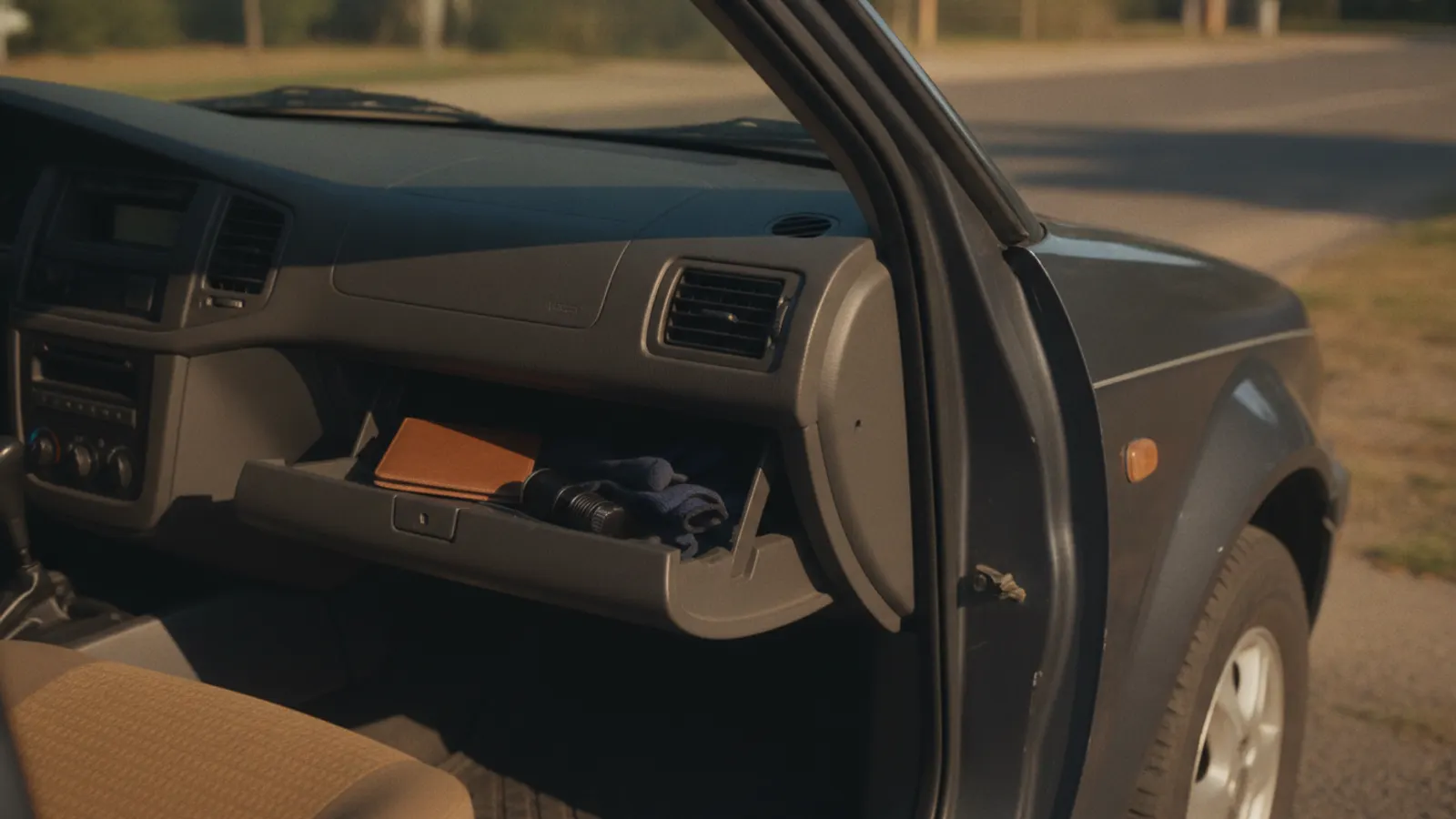
What to keep in the glovebox and on your phone
The documents, the numbers and the dated photographs a claim will ask for, assembled while you are calm — walked through one roadside moment at a time, item by item.
In the first two minutes after an impact you can stop the car, switch on the hazard lights, look at whether anyone is hurt, and get out. What the moment asks for next — a name, an address, an insurer’s phone number, a photograph taken from far enough back, a note of the time and place — is either already within reach or it does not get done. Nobody assembles a kit at the roadside.
So this piece walks one ordinary roadside moment through in order, naming at each step the item being reached for and what happens when it is not there. The moment is a genre rather than an event: there is no road in it, no city, no hour, no named insurer and no amount of money, because inventing those would make the description feel more real and be less true.
Stopping, and the part of the kit that is not an object
The Washington State Office of the Insurance Commissioner states the baseline flatly: every driver involved in an accident is legally required to remain at the scene, and must also offer aid and give necessary information to others involved and to law enforcement officers. Its first instruction after that is to use all means possible to warn oncoming traffic of the danger at the scene. The United Kingdom’s Highway Code says it in its own vocabulary: stop in a place of relative safety if possible, use your hazard warning lights to warn other traffic, and be prepared to exchange details.
Nothing in the glovebox helps with that minute. What helps is having read those sentences once before, in a chair, because the sequence they describe is not the one panic suggests, which is to look at the damage.
The card that is meant to be in the car
The first physical item is the smallest. The NAIC’s consumer guide gives it as a plain instruction to policyholders: keep your proof-of-insurance card in your car at all times, and most states require this.
Follow the moment forward and that one card is reached for three times. An officer who attends may ask to see it. The other driver is entitled to your details, and you read them off something rather than recall them. And when the scene is over and you are sitting somewhere quieter, the NAIC’s instruction for opening the claim is to call the phone number on your proof-of-insurance card as soon as possible.
When the card is not there, none of those moments fails outright. Each gets slower, and slower is the whole cost. In the United Kingdom the consequence is specified: the police may ask for the driving licence, the insurance certificate and the MOT certificate, and gov.uk states that a driver who does not have them has seven days to take them to a police station. The Highway Code sets the same seven days against the insurance certificate after a collision. Seven days is generous. It is also an errand scheduled by someone else.
What the other driver hands you, and what to do when they hand you nothing
The exchange is the part everyone assumes they can improvise, and the part with the most specific instructions attached. The NAIC guide says to get the other driver’s name and address and their insurance company’s name and phone number, and points out where that lives: on the proof-of-insurance card in their auto. So the moment depends on the other driver having done what the previous section describes. Often enough they have not. The guide’s fallback is the sentence worth committing to memory — if you cannot get this information, write down their driver’s licence number and licence plate number to give to your insurance company. Write down. Not photograph, not remember, not agree to sort it out later by text message.
The instruction specifies a kit item. A pen that works and a folded sheet of paper cost nothing, occupy no space, and are the only recording device at the scene that cannot run out of battery, crack, or be handed to an officer as evidence. The Highway Code’s rule 286 sets the same information moving in the other direction: you must stop and give your own and the vehicle owner’s name and address, and the registration number of the vehicle — and if those details are not given at the scene, report it to the police as soon as reasonably practicable, and in any case within 24 hours.
The list nobody remembers under stress
Then comes the part that is pure recall, the worst thing to ask of someone who has just been hit. The NAIC guide enumerates what to get at the scene: the other car’s make, model, year and licence plate number; witnesses’ names and contact information; the name, badge number and contact information for the officer who attends, and — the item people always lose — asking that officer when and where to get the accident report and its number. Then the time, date and exact location, with notes of skid marks, weather and road conditions, and a photograph or a sketched diagram of the scene.
The Texas Department of Insurance writes the photographic half as instructions to a phone: take a picture of the other driver’s insurance card and driving licence; get pictures of the other cars involved, including licence plates and damages; and get pictures of street signs and road angles.
Read as memory, that is an unreasonable list. Read as a printed card in a glovebox, it is a page. This is what the section’s claim readiness checklist exists to become: the same items, in an order you can hand to somebody else and print for every car you own. What happens when it is not there is that you remember the vehicles and forget the officer’s badge number, and the report you cannot then identify is the document both insurers would have accepted without argument.
The form, where a form exists
In some places the exchange has a standard instrument, and the instrument lives in the glovebox. Spain’s Dirección General de Tráfico tells drivers that it is necessary to fill in the corresponding European accident statement, the Declaración Amistosa de Accidente, and that all the data of the vehicles and the damage caused to people and to the vehicles involved must be entered on it. The DGT’s stated reason is procedural rather than legal: the form speeds up dealings between those involved and the insurance companies. The same page gives 112 as the emergency number.
Where that form is the customary instrument, carrying a blank copy is the cheapest preparation available, and carrying two is better, because the other driver will not have one. Where it is not, the folded sheet does the same work with less authority, and the point holds either way: one agreed description written at the scene beats two accounts reconstructed separately a week later.
The photographs taken on a calm afternoon
Everything so far is about the crash. One item is about the day before it, and it is the one most people skip.
Walk around the car with a camera once, in daylight, and photograph every panel, the wheels, the windscreen, the interior and the odometer, and do it again after any repair. The regulator’s reasoning is published about household contents rather than cars, and transfers cleanly. The Texas Department of Insurance says that not having a home inventory could delay your claims payment, because most insurance companies will want a record of your lost or damaged items before they will pay a personal property claim. The same department’s storage advice is the sharper half: keep the record away from the thing it describes — with someone else, in cloud storage, or in your own email.
What a dated set of photographs settles is narrow. It settles whether the scuff on the rear quarter was there in March. It is a small argument, and one of the few in a claim that a document can end outright rather than merely inform.
Why any of this is on paper
The phone is the better camera, the better notebook and the better map, and it has failure modes the glovebox does not. It runs out of battery late in the day, when traffic is worst. Its screen cracks, in exactly the impact that created the need for it. And it can be taken, lawfully and as evidence, by people who will return it later.
So the kit is deliberately redundant, and the paper half carries the things you cannot reconstruct: your own policy number, the claims line you would otherwise look up on a dying screen, the car’s registration details, and a name and number for someone who should be told. The NAIC guide extends the same discipline to the house — keep a file of all paperwork you completed online or received in the mail and signed, including the policy, its changes, renewal notices, correspondence, premium receipts, notes of conversations and any claims submitted. A company running several vehicles has the same problem multiplied by the drivers who were never told where any of it is kept.
The clock that starts when you call
The last step happens away from the road. The NAIC guide says to call the number on the card as soon as possible; Washington’s guide says it is equally important to promptly report the incident to your insurance company, and adds that you may be subject to other reporting requirements set out in your own policy. The NAIC gives one more instruction people tend to follow too late: if your car is damaged by a hit-and-run driver or is stolen, promptly call the police.
That call is what the kit is ultimately for, because it starts something. How long your insurer then has to send an acknowledgement, and afterwards to decide and to pay, is in the data below for your jurisdiction. Those clocks generally run from the notice you give, which is why the kit is not a tidiness exercise. It is the thing that shortens the distance between an impact and a file that exists.
The condition nobody prepares for
Read the list back and notice what every item has in common. The card, the pen, the printed page, the blank form, the photographs taken in March — none makes a competent person more competent. They exist because of a condition that appears on no list: the person who assembled the kit is the person standing at the roadside with their hands shaking, unable to remember the name of their own insurer.
That is the design brief. Not efficiency, and not thoroughness. Everything in the glovebox was chosen by someone calm, for someone who will not be.
Rules in your jurisdiction
Deadlines, fault rules and minimum coverage differ by state and country. Pick yours to see the rules that apply to this topic.
Select a jurisdiction to see its rules.
| Insurer response deadlines — Acknowledge the claim | 15 days from the claim [5] Calendar days, on a first-party claim, to acknowledge notice — unless the insurer pays within that time. The same fifteen days apply to providing claim forms and reasonable assistance, and an acknowledgement by the insurer’s producer satisfies the duty. |
|---|---|
| Insurer response deadlines — Accept or deny | 30 days from the claim [5] Calendar days after receipt of properly executed proofs of loss, “or the number of days specified in the policy” — the policy may give the insurer longer. A denial is invalid unless it names the provision, condition or exclusion relied on. The duty is suspended where the insurer has a documented, reasonable basis to suspect the claimant fraudulently caused or contributed to the loss. |
| Insurer response deadlines — Pay | 30 days from the claim [5] Calendar days, and the clock waits on all three conditions together: accepting liability, agreeing the amount, and receiving the documents needed to consummate the settlement. |
Verified as ofSeptember 15, 2026 · Car insurance claims in Alabama →
| Insurer response deadlines — Acknowledge the claim | 10 days from the claim [3] TEN WORKING DAYS, AND ALASKA IS ONE OF THE FEW STATES WHOSE RULE SPELLS THE DUTY OUT IDENTICALLY FOR A THIRD-PARTY CLAIMANT: a person claiming against the other driver’s insurer has the same acknowledgement right as the policyholder. First party: «within 10 working days after receipt of notification of a claim, give written acknowledgement to the first-party claimant identifying the person handling the claim, including the person’s name, address, telephone number, the firm name, and the file number; payment of the claim within 10 working days after notification is satisfactory acknowledgement» (3 AAC 26.040(a)(1)). Third party: «within 10 working days after notification of the claim from a third-party claimant, give written acknowledgement to the third-party claimant» (§ 26.040(b)(1)), with the same duty owed to the insured at (b)(4). A further «15 working days after receipt» governs «an appropriate reply to all other communications» from a first-party claimant (§ 26.040(a)(2)). NOTE THE UNIT — WORKING days, as in Nebraska, Arkansas and West Virginia, not the plain days of Hawaii, Iowa or South Dakota. |
|---|---|
| Insurer response deadlines — Accept or deny | 15 days from the claim [3] Fifteen WORKING days from proof of loss, with rolling forty-five-working-day status letters: an insurer «shall advise a first-party claimant in writing of the acceptance or denial of the claim within 15 working days after receipt of a properly executed statement of claim, proof of loss, or other acceptable evidence of loss unless another time limit is specified in the insurance policy … payment of the claim within this time limit constitutes written acceptance; a written denial of the claim must state the specific provisions, conditions, exclusions, and facts upon which the denial is based»; and where more time is needed, «written notification giving the reasons that more time is needed shall be given to the first-party claimant within the deadline. While the investigation remains incomplete, additional written notification shall be provided 45 working days from the initial notification, and no more than every 45 working days thereafter» (3 AAC 26.070(a)(1)). TWO QUALIFICATIONS BELONG WITH THE FIGURE. The fifteen days yield expressly to «another time limit … specified in the insurance policy», so the regulation is a DEFAULT, not a floor. And the duty is written for a FIRST-PARTY claimant; § 26.070(b) says something different about third parties, on which see the notes. |
| Insurer response deadlines — Pay | 30 days from the claim [3] Thirty WORKING days from proof of loss, and note precisely what it is a deadline to do: an insurer «shall, within 30 working days after receipt of a properly executed statement of claim, proof of loss, or other acceptable evidence of loss, pay those portions of the claim not in dispute» (3 AAC 26.070(a)(2)). A PARTIAL DISPUTE DOES NOT STOP THE CLOCK ON THE UNDISPUTED PART — that is the sentence a claimant facing a part-denied repair estimate needs. Separately, § 26.050(a) gives the insurer a THIRTY-WORKING-DAY INVESTIGATION PERIOD with an express due-diligence escape («shall complete the investigation within 30 working days, unless the investigation cannot reasonably be completed using due diligence»); that is not a decision deadline and is deliberately not published as one. |
Verified as ofSeptember 11, 2026 · Car insurance claims in Alaska →
| Insurer response deadlines — Pay | 60 days from the claim [1] A statutory condition deemed part of every policy, which «no variation or omission of or addition to» can make binding on the insured: the insurer «must pay the insurance money for which it is liable under the contract within 60 days after the proof of loss has been received by it or, where a dispute resolution process is conducted under Statutory Condition 4(9), within 15 days after the decision is rendered» (Insurance Act, s. 556, Statutory Condition 6(1)). |
|---|
Verified as ofSeptember 10, 2026 · Car insurance claims in Alberta →
| Insurer response deadlines — Accept or deny | 30 days from the claim [2] The insurer must rule on the insured’s right within 30 days of receiving the supplementary information it requested; silence counts as acceptance (Ley 17.418 art. 56). The insured must notify the loss within three days of knowing of it (art. 46). |
|---|---|
| Insurer response deadlines — Pay | 15 days from the claim [2] In property insurance, payment within 15 days of the amount being fixed or the offered indemnity accepted, once the art. 56 period has run (art. 49). |
Verified as ofSeptember 10, 2026 · Car insurance claims in Argentina →
| Insurer response deadlines — Acknowledge the claim | 10 days from the claim [4] Working days, not calendar days: «within 10 working days, acknowledge the receipt of the notice unless payment is made within the 10 working days», and notification to an agent of an insurer is notification to the insurer (A.A.C. R20-6-801(E)(1)). Supplying claim forms, instructions and reasonable assistance within the same 10 working days is compliance (E)(4). Every later communication from the claimant that reasonably suggests a response is expected carries its own 10 working days (E)(3). |
|---|---|
| Insurer response deadlines — Accept or deny | 15 days from the claim [4] Working days after receipt of properly executed proofs of loss, owed as written to the first party claimant; a denial must be in writing and must name the policy provision, condition or exclusion relied on (A.A.C. R20-6-801(G)(1)(a)). If more time is needed the insurer must say so with reasons within the same 15 working days, then write again at 45 days and every 45 days thereafter — plain days in that clause (G)(1)(b). Investigation must be completed within 30 days of notification «unless the investigation cannot reasonably be completed within 30 days» (F). |
Verified as ofSeptember 10, 2026 · Car insurance claims in Arizona →
| Insurer response deadlines — Pay | 60 days from the claim [4] The insurer «must pay the insurance money for which it is liable under this contract within 60 days after the proof of loss or statutory declaration has been received by it» or, where an arbitration is conducted under s. 177 of the regulation, «within 15 days after the award is rendered» (Insurance (Vehicle) Regulation, Schedule, statutory condition 8(1)). The sixty days run from the proof of loss, not from the accident. |
|---|
Verified as ofSeptember 10, 2026 · Car insurance claims in British Columbia →
| Insurer response deadlines — Acknowledge the claim | 15 days from the claim [4] Calendar days from notice of claim. |
|---|---|
| Insurer response deadlines — Accept or deny | 40 days from the claim [5] Calendar days from proof of claim; the insurer may extend with written notice every 30 days. |
| Insurer response deadlines — Pay | 30 days from the claim [5] Calendar days after the claim is accepted. |
Verified as ofSeptember 10, 2026 · Car insurance claims in California →
| Insurer response deadlines — Pay | 10 days from the claim [3] SOAP indemnities are paid within 10 days of presenting the required documents (police certificate, medical certificates, etc.) — Ley 18.490 art. 30. Applies to the compulsory personal-accident cover, not to liability claims. |
|---|
Verified as ofSeptember 10, 2026 · Car insurance claims in Chile →
| Insurer response deadlines — Pay | 1 months from the claim [3] The insurer must pay within the month following the date the insured or beneficiary proves their right, even out of court (Código de Comercio art. 1080, as amended by Ley 510 de 1999); afterwards default interest runs at the current bank rate increased by half. |
|---|
Verified as ofSeptember 10, 2026 · Car insurance claims in Colombia →
| Insurer response deadlines — Accept or deny | 60 days from the claim [4] Plain days, and one obligation rather than two: insurers «shall make a decision on claims and/or pay benefits due under the policy within sixty (60) days after receipt of a valid and complete claim» unless there is a reasonable dispute (3 CCR 702-5, Regulation 5-1-14 § 4(A)(1)(a)). A claim is «valid and complete» only once eight conditions are met — all necessary documents received, the insurer’s own reasonable investigation complete, coverage established, repairs finished and authorised, valuations concluded, any litigation finally adjudicated — and «the insured shall have the burden of proving to the Commissioner of Insurance that he/she submitted a valid and complete claim» (§ 4(A)(2)(a), (5)). First-party claims only. |
|---|---|
| Insurer response deadlines — Pay | 60 days from the claim [4] The same sixty plain days and the same single duty as the decision clock — the regulation says «decision on claims and/or pay benefits» — so this is not a second period running after a decision. Miss it without a reasonable dispute and the Commissioner may order the insurer to pay the insured 8 % annual interest on the benefits due, plus a civil penalty of $100 a day (Regulation 5-1-14 § 4(A)(1)(b)–(c)). A separate and much shorter rule reaches the person hit by somebody else’s insured: payment «within three (3) business days» of written acceptance of the settlement offer once a transferable title has been received (Regulation 5-2-15 § 5(B)(3)). |
Verified as ofSeptember 11, 2026 · Car insurance claims in Colorado →
Verified as ofSeptember 11, 2026 · Car insurance claims in Connecticut →
| Insurer response deadlines — Acknowledge the claim | 15 days from the claim [3] FIFTEEN WORKING DAYS, FROM THE REGULATION AND NOT FROM THE STATUTE: «Failing to acknowledge and respond within 15 working days, upon receipt by the insurer, to communications with respect to claims by insureds arising under insurance policies» is a prohibited unfair claim settlement practice (18 Del. Admin. Code 902, § 3.1.2), and § 3.1.3 adds «Failing to implement prompt investigation of claims arising under insurance policies within 10 working days upon receipt of the notice of loss by the insurer». TWO QUALIFICATIONS TRAVEL WITH THE FIGURE. The rule is worded for «claims by insureds», so it does not plainly reach a third-party claimant — unlike Alaska’s 3 AAC 26.040(b), which spells the same duty out for a third party. And the whole of § 3.1 bites only where the conduct is «committed or performed with such frequency as to indicate a general business practice», so a single overrun is not itself a violation. A SEPARATE AND NARROWER STATUTORY DUTY SITS BESIDE IT AND MUST NOT BE CONFLATED WITH IT: on a first-party injury-benefit claim «the insurer shall, no later than 10 days following the insurer’s receipt of said notification, provide that claimant with a form for filing such a claim», and a breach is priced at «1 percent of the amount due as of the date on which the claim was required to be provided for each day beyond the prescribed period for compliance, not to exceed $5,000» (tit. 21, § 2118B(b)). That ten days is a duty to SEND THE CLAIM FORM, not to acknowledge the claim, so it is recorded here rather than published as this field’s value. |
|---|---|
| Insurer response deadlines — Accept or deny | 30 days from the claim [3] Thirty PLAIN days — note the change of unit inside one rule, as in Arkansas’s Rule 43 and West Virginia’s C.S.R. 114-14: «Failing to affirm or deny coverage or a claim or advise the person presenting the claim, in writing, or other proper legal manner, of the reason for the inability to do so, within 30 days after proof of loss statements have been received by the insurer» (18 Del. Admin. Code 902, § 3.1.5). The regulation says «30 days» where §§ 3.1.2 and 3.1.3 say «working days», and Regulation 1310 — the health-claims rule that 902 § 3.6 points at — is the instrument that defines «“Days” means calendar days», not this one. The SAME thirty days do the same job on the statutory side for a first-party injury-benefit claim, where the insurer must within thirty days «make payment of the amount of claimed benefits that are due to the claimant or, if said claim is wholly or partly denied, provide the claimant with a written explanation of the reasons for such denial» (tit. 21, § 2118B(c)). |
| Insurer response deadlines — Pay | 30 days from the claim [4] THIRTY DAYS, AND THE SCOPE IS THE WHOLE POINT: this is the FIRST-PARTY INJURY-BENEFIT clock of tit. 21, § 2118B(c), not a general payment deadline. «When an insurer receives a written request for payment of a claim for benefits pursuant to § 2118(a)(2) …, the insurer shall promptly process the claim and shall, no later than 30 days following the insurer’s receipt of said written request for first-party insurance benefits AND documentation that the treatment or expense is compensable …, make payment» — so the trigger is the request PLUS the documentation, not the crash and not the request alone. The late-payment rate then ESCALATES IN THREE STEPS, a structure found in no other state in this dataset and one that must never be averaged into a single rate: «(1) One and one-half percent from the thirty-first day through the sixtieth day; and (2) Two percent from the sixty-first day through the one hundred and twentieth day; and (3) Two and one-half percent after the one hundred and twenty-first day» a month. NO DELAWARE PAYMENT DEADLINE FOR A VEHICLE-DAMAGE CLAIM WAS READ: Regulation 902 contains no payment deadline at all, and whether any Delaware instrument fixes a time to pay a settled motor property-damage claim has not yet been verified against a primary text and is not stated here. |
Verified as ofSeptember 11, 2026 · Car insurance claims in Delaware →
| Insurer response deadlines — Pay | 30 days from the claim [4] Plain days from the insurer’s receipt of reasonable proof of the fact and amount of loss, for personal injury protection benefits; after that the payment is overdue and bears interest at the District prime rate prevailing on the day it first went overdue. |
|---|
Verified as ofSeptember 15, 2026 · Car insurance claims in District of Columbia →
Verified as ofSeptember 10, 2026 · Car insurance claims in Dominican Republic →
| Insurer response deadlines — Accept or deny | 15 days from the claim [5] Under the Pre-Action Protocol for Low Value Personal Injury Claims in Road Traffic Accidents (claims up to £25,000), the defendant’s insurer must return the Claim Notification Form response within 15 days (para. 6.11). |
|---|
Verified as ofSeptember 10, 2026 · Car insurance claims in England and Wales →
| Insurer response deadlines — Pay | 30 days from the claim [2] Personal injury protection benefits are overdue if not paid within 30 days after the insurer is furnished written notice of the covered loss and its amount (§ 627.736(4)(b)). An agreed written settlement must be paid within 20 days, after which it bears 12 % interest (§ 627.4265). |
|---|
Verified as ofSeptember 10, 2026 · Car insurance claims in Florida →
| Insurer response deadlines — Accept or deny | 30 days from the claim [3] Thirty plain days, and the same thirty days close off the «we need more information» escape: «If the insurer elects to deny a claim for benefits in whole or in part, the insurer shall, within thirty days, notify the claimant in writing of the denial and the reasons for the denial», the notice «prepared and mailed by the insurer in triplicate copies and … in a format approved by the commissioner»; and «If the insurer cannot pay or deny the claim for benefits because additional information or loss documentation is needed, the insurer shall, within the thirty days, forward to the claimant an itemized list of all the required documents» (§ 431:10C-304(3)(B)–(C)). So an insurer cannot stop the clock by saying more information is needed without saying exactly what. These are the PIP clocks; Hawaii has no evidenced acknowledgement deadline — see the notes. |
|---|---|
| Insurer response deadlines — Pay | 30 days from the claim [3] Thirty plain days, and the trigger has two parts: «Payment of personal injury protection benefits shall be made within thirty days after the insurer has received reasonable proof of the fact and amount of benefits accrued, and demand for payment thereof» (§ 431:10C-304(3)(A)) — proof AND a demand, with all providers required to describe the service in conformity with the applicable fee-schedule codes. «Amounts of benefits that are unpaid thirty days after the insurer has received reasonable proof … shall bear interest at the rate of one and one-half per cent per month» (§ 431:10C-304(4)) — eighteen percent a year, on the same footing as the rate New Mexico reaches by a different route. Payment goes to the PROVIDER of services rather than to the injured person (§ 431:10C-304(1)). |
Verified as ofSeptember 11, 2026 · Car insurance claims in Hawaii →
| Insurer response deadlines — Pay | 30 days from the claim [5] THIRTY DAYS FROM PROOF OF LOSS — AND SIXTY WHERE THE PROOF OF LOSS PERTAINS TO UNINSURED OR UNDERINSURED MOTORIST BENEFITS, TWO CLOCKS IN ONE SENTENCE: «Any insurer … that fails to pay a person entitled thereto within thirty (30) days after proof of loss has been furnished as provided in such policy … or to pay to the person entitled thereto within sixty (60) days if the proof of loss pertains to uninsured motorist or underinsured motorist coverage benefits, the amount that person is justly due … shall in any action thereafter commenced against the insurer in any court in this state, OR IN ANY ARBITRATION for recovery under the terms of the policy, pay such further amount as the court shall adjudge reasonable as attorney’s fees» (§ 41-1839(1)). The sixty-day UM/UIM variant is found in no other jurisdiction in this dataset and is exactly the clock an Idaho claimant needs; the days are plain and unqualified in both limbs, so calendar days on the face of it. THE CONSEQUENCE IS FEE-SHIFTING, NOT INTEREST — contrast Hawaii’s 1.5 % a month and Maine’s combination of both — and it reaches an arbitration as well as a court action. STATE THE DEADLINE AND ITS TWO LIMITS TOGETHER OR NEITHER: an insurer that alleges «a tender of the full amount justly due was made» and then deposits that amount «in the court» owes no fees if the allegation is found true, or if it is determined that no amount is justly due; and § 41-1839 with § 12-123 is «the EXCLUSIVE remedy for the award of statutory attorney’s fees in all actions or arbitrations between insureds and insurers», with the general commercial fee statute § 12-120 expressly switched off (§ 41-1839(2), (4)). |
|---|
Verified as ofSeptember 11, 2026 · Car insurance claims in Idaho →
| Insurer response deadlines — Pay | 30 days from the claim [3] Payment within 30 days after the company affirms liability, where the amount is determined and not in dispute; a written explanation of a denial or lower offer within 30 days (50 Ill. Adm. Code 919.50(a)). Illinois sets no fixed day count to acknowledge or decide — the standard is «a reasonable time»; a first-party physical-damage claim unresolved 40 calendar days after report earns a written explanation (919.80(b)(2)). |
|---|
Verified as ofSeptember 10, 2026 · Car insurance claims in Illinois →
| Insurer response deadlines — Accept or deny | 20 days from the claim [3] Business days, and this clock is one the claimant starts: it runs from the insurer’s receipt of a written complaint that the commissioner has forwarded, not from the claim or the proof of loss. A claimant who believes an unfair claim settlement practice has been committed may complain to the commissioner, who has ten business days to deliver the complaint to the insurer and write back; the insurer then has twenty business days to give the commissioner and the complainant a written report with «the specific reasons for actions taken», the specific reasons for any inaction, and, if the claim is unsettled, «a good faith estimate of the time required for settlement» (Ind. Code § 27-4-1-5.6(c)–(d)). The Department states the same figure on its own complaint page. Indiana fixes no general acknowledgement, investigation, decision or payment period. |
|---|
Verified as ofSeptember 11, 2026 · Car insurance claims in Indiana →
| Insurer response deadlines — Acknowledge the claim | 15 days from the claim [3] Plain, unqualified days — chapter 191—15 defines no «day» and uses «business day» only in its annuity divisions. «Upon receiving notification of a claim, an insurer shall, within 15 days, acknowledge the receipt of such notice unless payment is made within that period of time» (r. 191—15.42(1)), and the rule states in its own words that «insurer» means property and casualty insurers, so it reaches a motor claim. A second, continuing fifteen-day duty runs for the life of the claim: a reply is owed within fifteen days to every pertinent communication that reasonably suggests a response is expected (r. 191—15.42(3)). |
|---|---|
| Insurer response deadlines — Accept or deny | 30 days from the claim [3] Thirty plain days from properly executed proofs of loss, and the duty is first-party by its own words: «Within 30 days after receipt by the insurer of properly executed proofs of loss, the first-party property claimant shall be advised of the acceptance or denial of the claim by the insurer», with any denial in writing citing the provision, condition or exclusion relied on (r. 191—15.41(2)). An extension is not open-ended: written reasons are owed within thirty days and again every forty-five days after (r. 191—15.41(3)). A third-party claimant’s equivalent is worded «within a reasonable time» and fixes no day count, so none is published for it. |
| Insurer response deadlines — Pay | 30 days from the claim [3] Thirty plain days from affirmation of liability, not from notice: «The insurer shall affirm or deny liability on claims within a reasonable time and shall tender payment within 30 days of affirmation of liability, if the amount of the claim is determined and not in dispute» (r. 191—15.41(6)). The affirm-or-deny half of the same subrule fixes no day count at all and must not be read as thirty days. Where several coverages are involved, an undisputed portion under one of them should be tendered within thirty days if paying it would end the insurer’s known liability under that coverage. |
Verified as ofSeptember 11, 2026 · Car insurance claims in Iowa →
| Insurer response deadlines — Pay | 30 days from the claim [3] Thirty plain days, and this is the PIP clock rather than a general payment duty: «Personal injury protection benefits payable under this act shall be overdue if not paid within thirty (30) days after the insurer or self-insurer is furnished written notice of the fact of a covered loss and of the amount of same, except that disability benefits payable under this act shall be paid not less than every two (2) weeks after such notice» (§ 40-3110(b)). Each part of a claim becomes overdue thirty days after the written notice supporting it. «All overdue payments shall bear simple interest at the rate of eighteen percent (18%) per annum.» The escape is stated in the same subsection: nothing is overdue where the insurer «has reasonable proof to establish that it is not responsible for the payment», even though written notice was furnished. Kansas has NO evidenced acknowledgement or affirm-or-deny deadline — see the notes. |
|---|
Verified as ofSeptember 11, 2026 · Car insurance claims in Kansas →
| Insurer response deadlines — Acknowledge the claim | 15 days from the claim [6] Business days, and the regulation sets the unit once by definition rather than per subsection: «Days» means «any day, Monday through Friday, except holidays» (806 KAR 12:095 § 1(5)). So the fifteen days in which an insurer must acknowledge receipt of a claim notice, unless it pays within that period, reach about three calendar weeks (§ 5(1)). Notice given to an agent of the insurer is notice to the insurer, and supplying necessary claim forms, instructions and reasonable assistance inside the same fifteen days is compliance (§ 5(4)). Every later pertinent communication that reasonably suggests a response is expected carries its own fifteen days (§ 5(3)). |
|---|---|
| Insurer response deadlines — Accept or deny | 30 days from the claim [6] Calendar days, expressly — this subsection overrides the regulation’s business-day default in its own words. The duty is to «offer any payment due within thirty (30) calendar days of receipt of proof of loss», which is a decision-and-offer duty rather than a bare affirm-or-deny, and on a multi-coverage claim the payments not in dispute must be tendered inside the same thirty calendar days (806 KAR 12:095 § 6(1)(a)). If more time is needed the insurer must say so within thirty calendar days and then write again at forty-five calendar days and every forty-five thereafter (§ 6(1)(c)–(d)). Where there is a supported basis to suspect the claimant caused the loss fraudulently, the day count is displaced rather than extended: the duty becomes acceptance or denial «within a reasonable time for full investigation» (§ 6(1)(b)). The affirm-or-deny duty of § 6(5) itself carries no day count at all — only «a reasonable time». |
| Insurer response deadlines — Pay | 30 days from the claim [2] Statutory rather than regulatory, and the days are unqualified in the statute, so they read as calendar days: reparation benefits are payable monthly as loss accrues and are «overdue if not paid within thirty (30) days after the reparation obligor receives reasonable proof of the fact and amount of loss realized» (KRS 304.39-210(1)(a)–(c)). The same paragraph allows a lawful alternative that can push a payment past day thirty: accumulating claims for periods not exceeding thirty-one days and paying within fifteen days after the period of accumulation. A proved fragment of a claim totalling $100 or more is overdue on its own (KRS 304.39-210(1)(e)), and overdue payments bear interest at twelve percent a year, or eighteen percent «if delay was without reasonable foundation» (KRS 304.39-210(2)). The regulation adds its own payment clock at 806 KAR 12:095 § 6(5), and the unit switches inside one sentence there — thirty business days from affirmation of liability, then thirty calendar days for undisputed multi-coverage payments. |
Verified as ofSeptember 11, 2026 · Car insurance claims in Kentucky →
| Insurer response deadlines — Acknowledge the claim | 14 days from the claim [5] This is a duty to START ADJUSTING, not a duty to acknowledge a letter, and it is labelled that way deliberately: «Except in the case of catastrophic loss, the insurer shall initiate loss adjustment of a property damage claim and of a claim for reasonable medical expenses within fourteen days after notification of loss by the claimant» — thirty days where the loss is catastrophic (La. R.S. 22:1892(A)(3)). Failure exposes the insurer to a penalty of the greater of five thousand dollars or the amount under subsection (I). Louisiana has no acknowledgement deadline of the usual shape, and whether any Insurance Department regulation adds one has not yet been verified against a primary text. |
|---|---|
| Insurer response deadlines — Pay | 30 days from the claim [5] Plain days, not business days, and there are two different triggers in adjacent paragraphs which this page does not merge. A first-party claim must be paid «within thirty days after receipt of satisfactory proofs of loss from the insured or any party in interest» (La. R.S. 22:1892(A)(1)). A third-party property damage claim or reasonable medical expenses claim must be paid «within thirty days after written agreement of settlement» (A)(2) — so the third-party clock starts at the written settlement, not at the crash and not at proofs of loss. A missed deadline is not automatically a penalty: subsection (B)(1)(a) awards fifty percent of the amount due, or one thousand dollars, whichever is greater, plus reasonable attorney fees and costs, only where the failure «is found to be arbitrary, capricious, or without probable cause», and a claim for those penalties itself prescribes in two years. |
Verified as ofSeptember 11, 2026 · Car insurance claims in Louisiana →
| Insurer response deadlines — Accept or deny | 30 days from the claim [3] THIRTY DAYS TO DISPUTE OR PAY, AND THE SAME SENTENCE DOES BOTH JOBS: «A claim for payment of benefits under a policy or certificate of insurance delivered or issued for delivery in this State is payable within 30 days after proof of loss is received by the insurer AND ascertainment of the loss is made either by written agreement between the insurer and the insured or beneficiary or by filing with the insured or beneficiary of an award by arbitrators as provided for in the policy. … A CLAIM THAT IS NEITHER DISPUTED NOR PAID WITHIN 30 DAYS IS OVERDUE. If, during the 30 days, the insurer, IN WRITING, notifies the insured or beneficiary that reasonable additional information is required, the undisputed claim is not overdue until 30 days following receipt by the insurer of the additional required information» (24-A M.R.S. § 2436(1)). THE TRIGGER IS TWO EVENTS, NOT ONE — proof of loss AND ascertainment of the loss — so the clock does not start on the notice of claim. The restart on additional information happens ONLY IF THE INSURER ASKED IN WRITING within the original thirty days; an oral request does not stop it. The fire and life exceptions in the same subsection are quoted so nobody imports them: a standard fire policy gets 60 days and individual life insurance 2 months, and NEITHER REACHES A MOTOR CLAIM. AND THE UNIT IS SETTLED BY THE LEGISLATURE’S OWN DRAFTING rather than by inference: subsection (1-A) says «30 CALENDAR days» where several carriers may be liable, so the plain «30 days» of subsection (1) are calendar days too and are expressly NOT working days. |
|---|---|
| Insurer response deadlines — Pay | 30 days from the claim [3] The SAME thirty days of § 2436(1): the claim «is payable within 30 days» and one that is «neither disputed nor paid within 30 days is overdue», so the decision and the payment share a single deadline rather than running consecutively as they do in Iowa, Kansas, Nebraska and West Virginia. Where more than one carrier may be liable the point is put beyond doubt: a claimant «may submit simultaneously a claim for payment with all carriers potentially liable», and «PAYMENT OR DENIAL of a claim by each carrier must be made within 30 CALENDAR days after the carrier has received all information needed to pay or deny the claim WHETHER OR NOT ANOTHER CARRIER with which it is attempting to coordinate has acted on the claim» (§ 2436(1-A), amended by PL 2025, c. 300) — so a Maine carrier may not wait on a co-ordinating carrier. MAINE STACKS BOTH CONSEQUENCES THAT OTHER STATES USE SINGLY: «the amount of the overdue claim or part of the claim bears interest at the rate of 1 1/2% per month after the due date», the same rate as Hawaii; AND «a reasonable attorney’s fee for advising and representing a claimant on an overdue claim … must be paid by the insurer if overdue benefits are recovered in an action against the insurer OR IF OVERDUE BENEFITS ARE PAID AFTER RECEIPT OF NOTICE OF THE ATTORNEY’S REPRESENTATION» (§ 2436(3)–(4)). That second limb is the practically useful one and appears on no other row in this dataset: the fee is owed even where the insurer simply pays up once it learns a lawyer is involved, with no judgment at all. |
Verified as ofSeptember 11, 2026 · Car insurance claims in Maine →
| Insurer response deadlines — Accept or deny | 30 days from the claim [1] This is the review clock, not a first-instance one: a claimant may apply in writing for a review «within 60 days after receiving notice of a decision», and «the corporation shall respond to the claimant within 30 days after receiving an application for review» (MPIC Act, s. 172(1), (3)). Every decision on a claim must be given in writing with reasons (s. 170(1)), and a review decision carries written reasons too (s. 173(2)), after which the claimant has 90 days to appeal to the Automobile Injury Compensation Appeal Commission (s. 174(1)). Whether any provision fixes a time for MPI to decide a claim in the first instance has not yet been verified against a primary text. |
|---|
Verified as ofSeptember 10, 2026 · Car insurance claims in Manitoba →
| Insurer response deadlines — Pay | 30 days from the claim [3] Plain days, and confined to the compulsory first-party benefits rather than to a liability settlement or a vehicle-damage payment: an insurer «shall make all payments of the benefits described in § 19-505 of this subtitle periodically as claims for the benefits arise and within 30 days after the insurer receives satisfactory proof of claim» (Insurance § 19-508(a)(1)), and overdue payments «shall bear simple interest at the rate of 1.5% per month» (§ 19-508(c)). A separate pair of clocks governs the uninsured and enhanced underinsured motorist route: once the claimant sends the liability insurer’s exhausting settlement offer to the UM insurer by certified mail, that insurer has 60 days to consent or refuse in writing and, if it refuses, 30 days to pay the amount of the offer itself (§§ 19-511(b)–(d), 19-511.1(b)–(d)). Maryland fixes no general acknowledgement, investigation or affirm-or-deny period in statute. |
|---|
Verified as ofSeptember 10, 2026 · Car insurance claims in Maryland →
| Insurer response deadlines — Acknowledge the claim | 2 days from the claim [6] Business days, and an assignment duty rather than an acknowledgement duty: «Assignment of an appraiser shall be made within two business days of the receipt of such claim», counted from an oral or written claim, and disapplied where the loss less any applicable deductible is under $1,500 (212 CMR 2.04(1)(a)). The appraisal itself must be transmitted within five business days of assignment. |
|---|---|
| Insurer response deadlines — Accept or deny | 15 days from the claim [3] Working days, in the statute’s own words, and triggered by the claimant’s written demand rather than by the accident: «The insurer shall, within fifteen working days after receipt of such written demand respond in writing setting forth its decision as to whether it accepts the claim, accepts a part of the claim, rejects the claim, or … the amount at which it is willing to compromise the claim» (M.G.L. c. 90, § 34O). The same section protects the claimant against the insured’s late notice provided the claimant sends the insurer written notice of the accident within thirty days of it. |
| Insurer response deadlines — Pay | 10 days from the claim [2] «upon notification of disability from a licensed physician, the insurer shall commence medical payments within ten days or give written notice of its intent not to make such payments, specifying reasons for said nonpayment»; benefits unpaid for more than thirty days make the unpaid party a party to a contract with the insurer, with a right to sue in contract and, on any recovery, costs and reasonable attorney’s fees (M.G.L. c. 90, § 34M). The statute says «days», not calendar or working days. On a first-party vehicle claim the count is seven days from receipt of the completed-work claim form (c. 90, § 34O). |
Verified as ofSeptember 10, 2026 · Car insurance claims in Massachusetts →
| Insurer response deadlines — Pay | 30 days from the claim [1] The clock runs from complete documentation, not from the crash and not from the notice: «El crédito que resulte del contrato de seguro vencerá treinta días después de la fecha en que la empresa haya recibido los documentos e informaciones que le permitan conocer el fundamento de la reclamación» (Ley sobre el Contrato de Seguro art. 71). A clause making the debt payable only once the insurer has acknowledged it, or a court has proved it, is void. |
|---|
Verified as ofSeptember 10, 2026 · Car insurance claims in Mexico →
| Insurer response deadlines — Acknowledge the claim | 30 days from the claim [5] Outside chapter 31: «An insurer shall specify in writing the materials that constitute a satisfactory proof of loss not later than 30 days after receipt of a claim unless the claim is settled within the 30 days», after which the amount supported by proof of loss is timely if paid within 60 days, and unpaid benefits bear 12 % simple interest from day 60 (MCL 500.2006(3)–(4)). Where this section and chapter 31 are specifically inconsistent, chapter 31 governs (§ 500.2006(6)), so for personal protection benefits the operative clock is MCL 500.3142. For a third-party tort claimant the interest additionally turns on bad faith found by a court, so the 60-day rule is not symmetrical between first and third party. |
|---|---|
| Insurer response deadlines — Pay | 30 days from the claim [5] Personal protection insurance benefits «are overdue if not paid within 30 days after an insurer receives reasonable proof of the fact and of the amount of loss sustained», and «an overdue payment bears simple interest at the rate of 12% per annum» (MCL 500.3142(2), (4)); where a bill for a product, service, accommodation or training reaches the insurer more than 90 days after it was provided, the insurer gets 60 days in addition to the 30 (§ 500.3142(3)). The statute says 30 and 60 days without saying calendar or working, and no word is added here. |
Verified as ofSeptember 10, 2026 · Car insurance claims in Michigan →
| Insurer response deadlines — Acknowledge the claim | 10 days from the claim [3] Business days after notification of the claim, to acknowledge it and provide all necessary claim forms and instructions — unless the claim is settled inside those same ten business days. |
|---|---|
| Insurer response deadlines — Accept or deny | 30 days from the claim [3] Business days after receipt of notification of the claim, to complete the investigation and inform the claimant of acceptance or denial; an extension requires a letter inside that period giving the reasons and the expected completion date. |
| Insurer response deadlines — Pay | 5 days from the claim [3] Business days from the later of the insurer’s receipt of the agreement and the claimant’s performance of the conditions it sets. |
Verified as ofSeptember 15, 2026 · Car insurance claims in Minnesota →
| Insurer response deadlines — Acknowledge the claim | 10 days from the claim [3] Working days, not calendar days: the insurer may acknowledge a first-party claimant’s notification by paying, by writing, or by an oral acknowledgment noted and dated in the claim file, in each case «within ten (10) working days» of receipt, and the same ten working days apply to «all communications from any claimant that reasonably suggests a response is expected» (20 CSR 100-1.030(1)(A)1.–3., (1)(B)). Providing the necessary claim forms, instructions and assistance within the same ten working days is itself compliance (§ 100-1.030(3)), and notification to any agent or producer representing the insurer counts as notification to the insurer. The statute adds one calendar-day figure of its own: fifteen calendar days to provide the forms needed to present a claim (§ 375.1007(13), RSMo). |
|---|---|
| Insurer response deadlines — Accept or deny | 15 days from the claim [3] Working days, and the trigger is not notice of the claim: «within fifteen (15) working days after the submission of all forms necessary to establish the nature and extent of any claim, the first-party claimant shall be advised of the acceptance or denial of the claim», and no claim may be denied on a specific policy provision, condition or exclusion unless the denial refers to it, in writing, with a copy in the file (20 CSR 100-1.050(1)(A)). If the insurer needs more time it must say so inside the same window with its reasons, and then write again «within forty-five (45) days» — plain days, in the same rule — and every forty-five days after (§ 100-1.050(1)(C)). Missouri has no investigation clock: the rule that once set one, 20 CSR 100-1.040, stands in the chapter under the words «(Rescinded July 30, 2008)». |
Verified as ofSeptember 11, 2026 · Car insurance claims in Missouri →
Verified as ofSeptember 11, 2026 · Car insurance claims in Montana →
| Insurer response deadlines — Acknowledge the claim | 15 days from the claim [3] FIFTEEN WORKING DAYS, NOT CALENDAR DAYS — the rule defines the unit for the whole chapter in its own definitions: «003.05 “Days” means working days». So «Every insurer, upon receiving notification of a claim shall, within fifteen (15) days, acknowledge the receipt of such notice unless payment is made within that period of time» (§ 006.01) is about three calendar weeks, not two. Notice to the insurer’s agent counts as notice to the insurer, unless the agent tells the claimant it is not authorised to receive notices of claim. Three parallel fifteen-working-day duties run beside it: a reply to any pertinent communication expecting a response (§ 006.03), supply of the necessary claim forms, instructions and reasonable assistance (§ 006.04), and an express duty to «initiate investigation» of the claim (§ 007). The statute independently confirms the unit: § 44-1540(14) fixes «fifteen working days» for claim forms. |
|---|---|
| Insurer response deadlines — Accept or deny | 15 days from the claim [3] Fifteen WORKING days again, and Nebraska’s trigger and its reach are both wider than most: «Within fifteen (15) days after receipt by the insurer of settlement information or a properly executed proof of loss, the claimant shall be advised of the acceptance or denial of the claim by the insurer», with any denial in writing citing the provision, condition or exclusion relied on and documented in the claim file (§ 008.01). The trigger is settlement information OR a proof of loss, whichever arrives first — broader than Iowa’s proof-of-loss-only trigger — and «claimant» is defined at § 003.04 to include THIRD-PARTY claimants, so the decision duty reaches the other driver’s claimant and not only the insured. An extension costs a written reason within fifteen days and a fresh written reason every thirty days after, and stops once the claim is in litigation (§ 008.02). |
| Insurer response deadlines — Pay | 15 days from the claim [3] Fifteen WORKING days from the claimant’s ACCEPTANCE, and it is the second of two distinct clocks in one subsection, which must not be merged: «In cases where there is no dispute as to coverage as to one or more portions of the insurance policy and where liability has become reasonably clear, the insurer shall offer to claimants, within fifteen (15) days of receipt of settlement information, amounts within policy limits which are fair and reasonable as shown by the insurer’s completed investigation. The insurer shall tender payment within fifteen (15) days of claimant’s acceptance» (§ 008.04). The same subsection requires payment of an undisputed portion notwithstanding disputes about other portions. |
Verified as ofSeptember 11, 2026 · Car insurance claims in Nebraska →
| Insurer response deadlines — Acknowledge the claim | 20 days from the claim [6] Working days, and the rule says so: every insurer must acknowledge receipt of a claim notice within 20 working days unless it pays within that time, and notice given to an agent of the insurer is notice to the insurer (NAC 686A.665(1)). Supplying claim forms, instructions and reasonable assistance inside the same 20 working days is compliance (NAC 686A.665(4)). The insurer must also begin investigating within 20 working days and complete the investigation within 30 plain days unless that reasonably cannot be done (NAC 686A.670). |
|---|---|
| Insurer response deadlines — Accept or deny | 30 days from the claim [6] Working days: «Within 30 working days after receipt by the insurer of properly executed proofs of loss, the first-party claimant must be advised of the acceptance or denial of the claim.» A denial must be in writing and may not rest on a policy provision, condition or exclusion unless the denial refers to it (NAC 686A.675(1)). If more time is needed the insurer must say so within the same 30 working days and write again every 30 days with reasons (NAC 686A.675(3)). |
| Insurer response deadlines — Pay | 30 days from the claim [6] Plain days here, and the unit switch is inside the same sentence pair as the 30 working days above: «If the claim of the first-party claimant is accepted, the insurer shall pay the claim within 30 days after it is accepted. If the accepted claim is not paid within that period, the insurer shall pay interest on the claim at the rate of interest established pursuant to NRS 99.040» (NAC 686A.675(1)). Where part of a claim is disputed, the undisputed portion must be paid anyway if that can be done without prejudice to an interested party (NAC 686A.675(7)). |
Verified as ofSeptember 11, 2026 · Car insurance claims in Nevada →
| Insurer response deadlines — Pay | 60 days from the claim [1] «The insurer shall pay the insurance money for which it is liable under this contract within sixty days after the proof of loss has been received by it or, where an appraisal is made under subcondition (8) of statutory condition 4, within fifteen days after the award is rendered by the appraisers» (Insurance Act, statutory condition 6(1)). Plain unqualified days, and word for word the same condition as Nova Scotia’s mandatory condition 6(1) and Newfoundland and Labrador’s equivalent — the Atlantic provinces share the machinery, which is exactly why the amounts and the limitation triggers must each be read from their own Act. The accident-benefit side of a New Brunswick policy sits in the Standard Automobile Policy prescribed by regulation, which was not opened, so no first-party payment clock is published. |
|---|
Verified as ofSeptember 11, 2026 · Car insurance claims in New Brunswick →
| Insurer response deadlines — Accept or deny | 7 days from the claim [5] Working days after notice of loss on a vehicle-damage claim, in which the insurer must inspect the vehicle, commence negotiations and make a good-faith offer of settlement — the three duties run together, not in sequence. |
|---|---|
| Insurer response deadlines — Pay | 30 days from the claim [5] Calendar days, the maximum payment period for a physical-damage claim, measured from receipt of notice of loss to the settlement cheque, the return of the repaired vehicle or its replacement. Past that, a written explanation of the delay is owed — and owed again every thirty calendar days. |
Verified as ofSeptember 15, 2026 · Car insurance claims in New Jersey →
| Insurer response deadlines — Pay | 45 days from the claim [3] Forty-five days from proof of loss, and this is the ONE hard insurer day count in New Mexico law: an insurer «that fails for a period of forty-five days, after required proof of loss has been furnished, to pay to the person entitled the amount justly due shall be liable for the amount due and unpaid with interest on that amount at the rate of one and one-half times the prime lending rate for New Mexico banks during the period the claim is unpaid. Interest shall accrue, and the interest rate shall be determined, as of the forty-sixth day after the proof of loss was furnished» (§ 59A-16-21(B)). THE RATE IS FLOATING AND NO PERCENTAGE IS PRINTED FOR IT, because the statute prints none. Subsection (C) takes the whole mechanism away once the claim is in arbitration or litigation. NEW MEXICO HAS NO ACKNOWLEDGEMENT OR AFFIRM-OR-DENY DEADLINE, and that is an evidenced finding rather than a gap — see the notes. |
|---|
Verified as ofSeptember 11, 2026 · Car insurance claims in New Mexico →
| Insurer response deadlines — Pay | 30 days from the claim [1] First-party (no-fault) benefits are overdue if not paid within 30 days after the claimant supplies proof of the fact and amount of loss; overdue payments bear 2 % per month plus a reasonable attorney’s fee (Ins. Law § 5106(a)). The Department of Financial Services’ claims regulation (11 NYCRR 216) sets further deadlines that could not be read for this page and are not stated. |
|---|
Verified as ofSeptember 10, 2026 · Car insurance claims in New York →
| Insurer response deadlines — Pay | 60 days from the claim [1] «The insurer shall pay the insurance money for which it is liable under this contract within 60 days after the proof of loss has been received by it or, where an appraisal is made …» (Automobile Insurance Act, statutory condition on payment of insurance money) — plain unqualified days, and the same figure as Nova Scotia’s mandatory condition 6(1) and New Brunswick’s statutory condition 6(1). One further clock favours the claimant: where the insurer has a person medically examined and receives a report, it must ensure the person receives a copy within sixty days of the insurer receiving it. The province’s compulsory accident benefits are set by regulation and were not reached, so no first-party payment clock is published. |
|---|
Verified as ofSeptember 11, 2026 · Car insurance claims in Newfoundland and Labrador →
| Insurer response deadlines — Pay | 10 days from the claim [4] Business days after the claim is settled: “Loss and claim payments shall be mailed or delivered within 10 business days after the claim is settled.” North Carolina fixes no acknowledgement deadline at all, and none is stated here. |
|---|
Verified as ofSeptember 15, 2026 · Car insurance claims in North Carolina →
| Insurer response deadlines — Pay | 30 days from the claim [4] THIRTY DAYS FROM REASONABLE PROOF — BUT THE ACCUMULATION RULE MUST TRAVEL WITH IT OR THE DEADLINE IS OVERSTATED. «1. BASIC AND OPTIONAL EXCESS NO-FAULT BENEFITS ARE PAYABLE MONTHLY for economic loss … 2. Basic and optional excess no-fault benefits ARE OVERDUE IF NOT PAID WITHIN THIRTY DAYS AFTER THE BASIC NO-FAULT INSURER RECEIVES REASONABLE PROOF OF THE FACT AND THE AMOUNT OF LOSS SUSTAINED, EXCEPT THAT THE BASIC NO-FAULT INSURER MAY ACCUMULATE CLAIMS FOR PERIODS NOT EXCEEDING ONE MONTH, AND THE BENEFITS ARE NOT OVERDUE IF PAID WITHIN TWENTY DAYS AFTER THE PERIOD OF ACCUMULATION. If reasonable proof is not supplied as to the entire claim, THE AMOUNT SUPPORTED BY REASONABLE PROOF IS OVERDUE IF NOT PAID WITHIN THIRTY DAYS after the proof is received … PAYMENT IS DEEMED MADE ON THE DATE OF MAILING. All overdue payments must bear interest at the judgment rate allowed in section 28-20-34» (§ 26.1-41-09(1)–(2)). So the insurer may batch claims for up to a month and then has a FURTHER TWENTY DAYS, and the real outside limit on a batched claim is longer than thirty days; partial proof triggers partial payment on its own thirty-day clock; and payment counts as made ON MAILING rather than on receipt. THE DAYS ARE PLAIN AND UNQUALIFIED, so calendar days on the face of it. NO PERCENTAGE IS PRINTED FOR THE OVERDUE INTEREST, AND THE OMISSION IS DELIBERATE: the rate is the judgment rate incorporated from § 28-20-34, which was not opened, so the rate has not yet been verified against a primary text and is not stated here — the same discipline New Mexico’s floating prime-rate row required. THIS FIELD IS A FIRST-PARTY DUTY ONLY and must not be read as a payment clock on a liability claim against the other driver’s insurer. One neighbouring rule in the same section is worth knowing and has no analogue on any other row in this dataset: «3. NEITHER THE INJURED PERSON NOR A BASIC NO-FAULT INSURER IS REQUIRED TO PAY FOR SERVICES BILLED MORE THAN ONE HUNDRED EIGHTY DAYS AFTER THE DATE OF TREATMENT», so a provider who bills late can be paid by nobody — not the insurer and not the patient. |
|---|
Verified as ofSeptember 11, 2026 · Car insurance claims in North Dakota →
Verified as ofSeptember 10, 2026 · Car insurance claims in Northern Ireland →
| Insurer response deadlines — Pay | 60 days from the claim [4] Nova Scotia runs two payment clocks and publishing only one misstates the province. The sixty days here is the property and indemnity clock: the insurer «shall pay the insurance money for which it is liable under this contract within sixty days after the proof of loss has been received by it or, where an appraisal is made …, within fifteen days after the award is rendered by the appraisers» (mandatory condition 6(1)). On the first-party Section B side the clock is half as long: «all amounts payable under this section, other than benefits under Part II of subsection 2, shall be paid by the Insurer within 30 days after it has received proof of claim», and recurring income benefits are then payable «within each 30-day period while the Insurer remains liable» on proof of continuing disability (Section B, subsection (7)(a)). |
|---|
Verified as ofSeptember 11, 2026 · Car insurance claims in Nova Scotia →
| Insurer response deadlines — Acknowledge the claim | 30 days from the claim [4] Plain days, and the unqualified form is deliberate: the same Act writes «twenty (20) calendar days» at 36 O.S. § 1250.4(B) where it means calendar days, so a bare «days» is the legislature’s own unqualified form and is reproduced rather than resolved. «Every property and casualty insurer, within thirty (30) days after receiving notification of a claim, shall acknowledge the receipt of such notification unless payment is made within such period of time», and notification given to an agent is notification to the insurer (§ 1250.6(A)). Supplying claim forms, instructions and reasonable assistance inside the same thirty days is compliance (§ 1250.6(B)). Every later pertinent communication from the claimant that reasonably suggests a response is expected — e-mail and a documented verbal communication included — carries its own thirty days (§ 1250.4(C)). |
|---|---|
| Insurer response deadlines — Accept or deny | 60 days from the claim [4] Plain days again, and the duty is softer than a hard affirm-or-deny: «Within sixty (60) days after receipt by a property and casualty insurer of properly executed proofs of loss, the first party claimant shall be advised of the acceptance or denial of the claim by the insurer, or if further investigation is necessary» — so the insurer discharges it by saying it needs to keep investigating. A denial must be written and may not rest on a policy provision, condition or exclusion unless the denial refers to it (36 O.S. § 1250.7(A)). Investigation must be completed within sixty days of notification of proof of loss, with a reasons letter at sixty days and, unusually among the states in this dataset, a hard outer cap: «the time for investigation shall not exceed one hundred twenty (120) days after receipt of proof of loss», defeasible only for evidenced fraud or arson (§ 1250.7(C)). The Commissioner may add twenty days after a Governor-declared catastrophe, and every clock in the section switches off once suit is filed (§ 1250.7(G)). |
Verified as ofSeptember 11, 2026 · Car insurance claims in Oklahoma →
| Insurer response deadlines — Accept or deny | 10 days from the claim [4] Business days: for the statutory accident benefits your own insurer pays, it must pay or give written notice of refusal within 10 business days of receiving the application and disability certificate (O. Reg. 34/10, s. 36(4)). You must notify the insurer of your intention to claim within seven days of the accident (s. 32(1)). |
|---|
Verified as ofSeptember 10, 2026 · Car insurance claims in Ontario →
| Insurer response deadlines — Accept or deny | 60 days from the claim [1] Calendar days, and this is a personal-injury-protection denial deadline rather than a general affirm-or-deny duty: an insurer denying PIP benefits must give written notice within 60 calendar days of receiving the provider’s claim, stating the reason and the method of contesting the denial (ORS 742.528). The same 60 calendar days make a provider’s charges presumed reasonable and necessary if they are not denied (ORS 742.524(1)(a)). PIP benefits themselves must be paid «promptly after proof of loss», with no day count (ORS 742.520(4)). |
|---|
Verified as ofSeptember 11, 2026 · Car insurance claims in Oregon →
| Insurer response deadlines — Acknowledge the claim | 10 days from the claim [3] Working days: acknowledge the notice of claim and provide claim forms and instructions within 10 working days (31 Pa. Code § 146.5(a), (d)). |
|---|---|
| Insurer response deadlines — Accept or deny | 15 days from the claim [3] Working days after receipt of properly executed proofs of loss; a denial must cite the policy provision relied on; extensions require written reasons, then letters every 45 days (§ 146.7(a)(1), (c)(1)). Investigation is to be completed within 30 days of notice (§ 146.6). |
| Insurer response deadlines — Pay | 30 days from the claim [1] First-party benefits are overdue if not paid within 30 days after the insurer receives reasonable proof of the amount; overdue benefits bear 12 % a year and, where the refusal was unreasonable, an attorney fee (75 Pa.C.S. § 1716). |
Verified as ofSeptember 10, 2026 · Car insurance claims in Pennsylvania →
| Insurer response deadlines — Accept or deny | 30 days from the claim [5] Insurance-contract claims, not SOAT claims, and the mechanism matters: where there is objectively no adjustment agreement, the loss «se entenderá como consentido … cuando la aseguradora no se haya pronunciado sobre el monto reclamado en un plazo que no exceda de los treinta (30) días contados desde la fecha de haberse completado toda la documentación exigida en la póliza» — thirty days of silence after complete documentation deems the loss consented. Payment is then due within a further thirty days of that consent, with default interest at one and a half times the average active lending rate (Ley 29946 art. 74). |
|---|---|
| Insurer response deadlines — Pay | 10 days from the claim [3] SOAT indemnities are paid «dentro del plazo máximo de diez (10) días siguientes a la presentación de los antecedentes» the regulation lists — the traffic-accident record form and, as the case requires, the death certificate, medical certificate or invoices (TUO art. 33). The clock is document-triggered, not accident-triggered. |
Verified as ofSeptember 10, 2026 · Car insurance claims in Peru →
| Insurer response deadlines — Pay | 60 days from the claim [3] A Civil Code duty, not a regulator’s service standard: the insurer «is bound to pay the indemnity within 60 days after receiving the notice of loss or, if the insurer requested them, the relevant information and vouchers» (art. 2473), and the insured must declare a loss to the insurer as soon as they become aware of it (art. 2470). |
|---|
Verified as ofSeptember 10, 2026 · Car insurance claims in Quebec →
| Insurer response deadlines — Accept or deny | 30 days from the claim [4] THIRTY DAYS TO RESPOND TO A CLAIM, EXTENDABLE ONLY BY THE INSURED’S AGREEMENT: «(16) FAILING TO RESPOND TO A CLAIM WITHIN THIRTY (30) DAYS, UNLESS THE INSURED SHALL AGREE TO A LONGER PERIOD» (§ 27-9.1-4(a)(16)). RHODE ISLAND HAS THE MOST NUMERICALLY SPECIFIC CLAIM-HANDLING TIMETABLE IN THIS DATASET AND IT MIXES BOTH UNITS INSIDE ONE SECTION, WHICH IS EXACTLY WHY EACH UNIT IS QUOTED RATHER THAN PARAPHRASED. Beside the thirty days: «(13) failing to provide forms necessary to present claims WITHIN TEN (10) CALENDAR DAYS of a request with reasonable explanations regarding their use»; and on the vehicle itself, «(26) failure to perform an initial appraisal WITHIN THREE (3) BUSINESS DAYS after a request is received from an auto body repair shop», provided the damaged vehicle is on the shop’s premises when the request is made, «and failure to perform a supplemental appraisal inspection of a vehicle WITHIN FOUR (4) BUSINESS DAYS after a request is received from an auto body repair shop. IF THE INSURER’S APPRAISER FAILS TO INSPECT THE DAMAGED MOTOR VEHICLE WITHIN THE ALLOTTED NUMBER OF BUSINESS DAYS … THE INSURER SHALL FORFEIT ITS RIGHT TO INSPECT THE DAMAGED VEHICLE PRIOR TO REPAIRS, AND NEGOTIATIONS SHALL BE LIMITED TO LABOR AND THE PRICE OF PARTS and shall not, unless objective evidence to the contrary is provided by the insurer, INVOLVE DISPUTES AS TO THE EXISTENCE OF DAMAGE OR THE CHOSEN MANNER OF REPAIR.» That forfeiture is self-executing and is the most useful consequence attached to any missed deadline in this dataset. One further practice is worth knowing in itself: «(15) MISLEADING A CLAIMANT AS TO THE APPLICABLE STATUTE OF LIMITATIONS.» A LIMIT ON ALL OF IT IS PUBLISHED ON THE FACE OF THIS ROW RATHER THAN LEFT OUT, BECAUSE IT IS A REAL GATE AND NOT A QUIBBLE: the section’s opening words make each listed act an unfair claims practice only «IF COMMITTED IN VIOLATION OF § 27-9.1-3», and § 27-9.1-3 WAS NOT READ. So these figures are published as the statute’s own prohibitions, whose trigger has not yet been verified against a primary text, and not as free-standing deadlines a claimant can enforce without more. |
|---|
Verified as ofSeptember 11, 2026 · Car insurance claims in Rhode Island →
Verified as ofSeptember 10, 2026 · Car insurance claims in Saskatchewan →
Verified as ofSeptember 10, 2026 · Car insurance claims in Scotland →
Verified as ofSeptember 11, 2026 · Car insurance claims in South Carolina →
| Insurer response deadlines — Acknowledge the claim | 30 days from the claim [3] THIRTY DAYS, AND IN SOUTH DAKOTA THE CLOCK IS STATUTORY RATHER THAN ADMINISTRATIVE — unlike Alaska, Delaware, Nebraska and West Virginia, where the numbers live in a regulation. «In dealing with the insured or representative of the insured, unfair or deceptive acts or practices in the business of insurance include, but are not limited to, the following: (1) Failing to acknowledge and act within thirty days upon communications with respect to claims arising under insurance policies and to adopt and adhere to reasonable standards for the prompt investigation of such claims» (§ 58-33-67(1), history «SL 1986, ch 422, § 2; SL 1989, ch 439, § 3»). Note that ONE CLOCK COVERS BOTH DUTIES — to acknowledge AND to act — which is unusual. The days are PLAIN AND UNQUALIFIED: the section says neither «business» nor «working», so they are calendar days on the face of it, as in Hawaii and Iowa and unlike Alaska’s and Nebraska’s working days. TWO LIMITS TRAVEL WITH THE FIGURE. The section is worded «in dealing with the insured or representative of the insured», so it does not plainly reach a third-party claimant. And § 58-33-69 says in terms that «nothing in §§ 58-33-66 to 58-33-69, inclusive, grants a private right of action», so the thirty days are the Division of Insurance’s to enforce and not the policyholder’s — the same shape as West Virginia’s § 33-11-4a. NO AFFIRM-OR-DENY OR PAYMENT DEADLINE IS PUBLISHED FOR SOUTH DAKOTA, and the reason is stated in the notes rather than left as silence. |
|---|
Verified as ofSeptember 11, 2026 · Car insurance claims in South Dakota →
| Insurer response deadlines — Accept or deny | 3 months from the claim [3] Reasoned offer (oferta motivada) or reasoned reply within three months of the claim, for injuries and for property damage alike; late payment accrues statutory interest. |
|---|
Verified as ofSeptember 10, 2026 · Car insurance claims in Spain →
| Insurer response deadlines — Acknowledge the claim | 15 days from the claim [3] Calendar days from notice of the claim, to acknowledge, start investigating and request the documents it needs (30 business days for surplus-lines insurers). |
|---|---|
| Insurer response deadlines — Accept or deny | 15 days from the claim [3] Business days after the insurer receives every item it required for final proof of loss; it may extend once by 45 days with written reasons. |
| Insurer response deadlines — Pay | 5 days from the claim [3] Business days after it notifies you that it will pay. |
Verified as ofSeptember 10, 2026 · Car insurance claims in Texas →
| Insurer response deadlines — Pay | 30 days from the claim [1] This is the personal-injury-protection payment clock and the only statutory clock Utah has. Benefits are payable monthly as expenses are incurred, and «benefits for any period are overdue if they are not paid within 30 days after the insurer receives reasonable proof of the fact and amount of expenses incurred during the period»; where reasonable proof covers only part of a claim, the proved part is overdue on its own. Late benefits bear interest at one and a half percent a month, and an insurer made to pay overdue benefits by an action must also pay the claimant a reasonable attorney’s fee (§ 31A-22-309(5)). No acknowledgement or decision deadline is stated on this page: § 31A-26-301(1)(b) leaves «the periods of time within which payment is required to be made to be timely» to a commissioner’s rule, and that rule has not yet been verified against a primary text. |
|---|
Verified as ofSeptember 11, 2026 · Car insurance claims in Utah →
Verified as ofSeptember 11, 2026 · Car insurance claims in Vermont →
| Insurer response deadlines — Acknowledge the claim | 10 days from the claim [4] Business days, and the rule says so: within 10 business days of a notification of claim under an individual policy the insurer must acknowledge receipt, and the same 10 business days apply to any later communication from a claimant that reasonably suggests a reply is expected (WAC 284-30-360(1), (3)). Group contracts get 15. Converting this to calendar days would misstate the rule. |
|---|---|
| Insurer response deadlines — Accept or deny | 30 days from the claim [4] Calendar days here, and the chapter says so: the investigation must be completed within 30 calendar days of the notification unless it reasonably cannot be, in which case the claimant is owed written reasons and a fresh written notice every 30 days (WAC 284-30-370(1)(a)–(b)); within 30 calendar days of the notification the insurer must tell a first-party claimant in writing whether the claim is accepted or denied, and a denial must reference the specific provision, condition or exclusion relied on (WAC 284-30-380(1), (3)). |
| Insurer response deadlines — Pay | 15 days from the claim [4] Business days again: 15 business days to deliver payment of a settled claim after properly executed releases or other settlement documents reach the insurer or its attorney, 20 business days to furnish a release the insurer owes, and 3 business days for a settlement draft to be honoured after notice of receipt by the payor bank (WAC 284-30-330(15), (16)). The 15 days yield to any statute, rule or contract term that sets its own payment time. A supplemental estimate or final invoice from the chosen repair facility gets an answer in writing within 5 business days (WAC 284-30-390(1)(b)(iii)). |
Verified as ofSeptember 10, 2026 · Car insurance claims in Washington →
| Insurer response deadlines — Acknowledge the claim | 15 days from the claim [3] Fifteen WORKING days: «Every insurer, upon receiving notification of a claim shall, within fifteen (15) working days, acknowledge the receipt of such notice unless full payment is made within such period of time. If an acknowledgment is made by means other than writing, an appropriate notation of such acknowledgment shall be made in the claim file of the insurer and dated. Notification given to an agent of an insurer shall be notification to the insurer» (W. Va. C.S.R. § 114-14-5.1). The escape is FULL payment, not part payment. The same fifteen working days apply to a reply to any other pertinent communication from a claimant that reasonably suggests a response is expected (§ 5.3), and to a complete written response to an inquiry from the Insurance Commissioner other than notice of a third-party administrative complaint (§ 5.2). |
|---|---|
| Insurer response deadlines — Accept or deny | 30 days from the claim [3] THIRTY CALENDAR DAYS IS THE OUTER CLOCK, AND THE STRUCTURE IS UNLIKE ANY OTHER STATE IN THIS DATASET — THREE UNITS IN TWO SUBSECTIONS, QUOTED AS WRITTEN. «If the insurer needs more than thirty (30) calendar days from the date that a proof of loss from a first-party claimant or notice of claim from a third-party claimant is received to determine whether a claim should be accepted or denied, it shall so notify the claimant in writing within fifteen (15) working days after the thirty-day period expires. If the investigation remains incomplete, the insurer shall provide written notification of the delay to the claimant every forty-five (45) calendar days thereafter until the investigation is complete» (§ 114-14-6.7). Note the trigger differs by claimant: proof of loss for a first party, notice of claim for a third party. Separately, once the investigation is actually complete the insurer has only ten working days to act: «Within ten (10) working days of completing its investigation, the insurer shall deny the claim in writing or make a written offer» (§ 114-14-6.3). |
| Insurer response deadlines — Pay | 15 days from the claim [3] Fifteen WORKING days from the agreement or from the claimant’s performance of any condition, whichever is later: «Every insurer shall pay any amount finally agreed upon in settlement of all or part of any claim not later than fifteen (15) working days from the receipt of such agreement by the insurer or from the date of the performance by the claimant of any condition set by such agreement, whichever is later» (§ 114-14-6.11). It reaches part-settlements as well as whole ones. |
Verified as ofSeptember 11, 2026 · Car insurance claims in West Virginia →
| Insurer response deadlines — Acknowledge the claim | 10 days from the claim [8] Consecutive days — the rule’s own word, so calendar days — because the administrative rule requires insurers to acknowledge communications and provide forms «promptly» and then defines the word: «the terms “prompt” and “promptly” as used in this rule shall mean responsive action within 10 consecutive days from receipt of a communication concerning a claim» (Wis. Admin. Code § Ins 6.11(4)). Two limits travel with it: the definition is expressly subordinate, «except where a different period is specified by statute or rule», and § Ins 6.11(3)(a) bites only on conduct «without just cause and performed with such frequency as to indicate general business practice». Wisconsin has no decision clock at all — the duty to affirm or deny coverage is stated only as «within a reasonable time after proof of loss has been completed» (§ Ins 6.11(3)(a)7.), with no day count anywhere in the chapter. |
|---|
Verified as ofSeptember 11, 2026 · Car insurance claims in Wisconsin →
| Insurer response deadlines — Accept or deny | 45 days from the claim [3] FORTY-FIVE DAYS, AND ONE SENTENCE DOES THE WORK OF THREE CLOCKS — acceptance, rejection AND payment — which no other jurisdiction in this dataset achieves in a single provision: «Claims for benefits under a property or casualty insurance policy shall be rejected or accepted and paid by the insurer or its agent designated to receive those claims within forty-five (45) days after receipt of the claim and supporting bills» (§ 26-15-124(b)). Subsection (a) sets the same forty-five days for life, accident and health claims «after receipt of the proofs of loss and supporting evidence», with an exception where an accident-and-health question goes to the Wyoming state medical peer review committee. The days are PLAIN AND UNQUALIFIED — the section says neither «business» nor «working» — so calendar days on the face of it. AND NOTE THE TRIGGER: «receipt of the claim and supporting BILLS», not a formal proof of loss, which for a vehicle claim is the repair invoice. |
|---|---|
| Insurer response deadlines — Pay | 45 days from the claim [3] The SAME forty-five days of § 26-15-124(b): the sentence requires the claim to be «rejected or accepted AND PAID … within forty-five (45) days after receipt of the claim and supporting bills», so the decision and the payment share one deadline rather than running consecutively as they do in Iowa, Kansas, Nebraska and West Virginia. THE REMEDY FOR THE OVERRUN IS FIXED AND PRINTABLE, UNLIKE NEW MEXICO’S FLOATING RATE: «if it is determined that the company refuses to pay the full amount of a loss covered by the policy and that the refusal is unreasonable or without cause, any court in which judgment is rendered for a claimant may also award a reasonable sum as an attorney’s fee and interest at ten percent (10%) per year» (§ 26-15-124(c)). Note what is weaker and what is stronger than in South Dakota: the standard is «unreasonable or without cause» rather than «vexatious or without reasonable cause», but the award is DISCRETIONARY («may») where South Dakota’s § 58-12-3 is mandatory. |
Verified as ofSeptember 11, 2026 · Car insurance claims in Wyoming →
Frequently asked questions
Is a photograph of my insurance card on my phone enough?
It depends on where you drive and on what your own documents say, so check both rather than assume. The NAIC's consumer guide tells drivers to keep the proof-of-insurance card in the car at all times and says most states require it. In the United Kingdom the police may ask for the driving licence, the insurance certificate and the MOT certificate, and gov.uk states that a driver who does not have them has seven days to take them to a police station. A photograph on a phone with no battery is not a document.
What do I do if the other driver has no insurance card?
Write down what identifies them and the car. The NAIC guide says that when you cannot get the other driver's name, address and insurer details, you should write down their driver's licence number and licence plate number to give to your insurance company. That instruction assumes something to write with, which is the argument for keeping a pen and a folded sheet of paper where you can reach them.
Do dated photographs of my car actually prove anything?
They show what the car looked like on one day, which is narrower than people assume and more useful than they expect. The Texas Department of Insurance makes the underlying point about household property rather than cars: most insurance companies want a record of the lost or damaged items before they will pay a personal property claim, and not having one can delay payment. A photograph does not establish how damage happened or who caused it; it removes the argument about whether it was already there.
This guide explains how car insurance claims generally work. It is not legal advice, does not create a lawyer–client relationship, and is not a statement of any insurer's or regulator's position. Rules change and differ by jurisdiction; check the cited instrument and, where money or injury is at stake, consult a licensed professional in your jurisdiction.