
Brakes, tyres, lights: the checks that change the odds
Not a service manual. What a soft pedal or a worn tyre actually does to a crash, when each defect announces itself, and the check that takes two minutes before a long drive.
Defects do not announce themselves at random. Each one has a moment when it becomes noticeable, and the moments are spread across a journey in a fixed order: some are visible while the car is cold and parked, some in the first hundred metres, some only at speed, and one is never noticeable at all and has to be read off a date stamped into the rubber.
That order is what this piece follows. It is not a service manual, and none of it replaces a mechanic. It is the set of things a driver can detect without tools, and what each one does to the odds if it is left alone.
Cold and parked
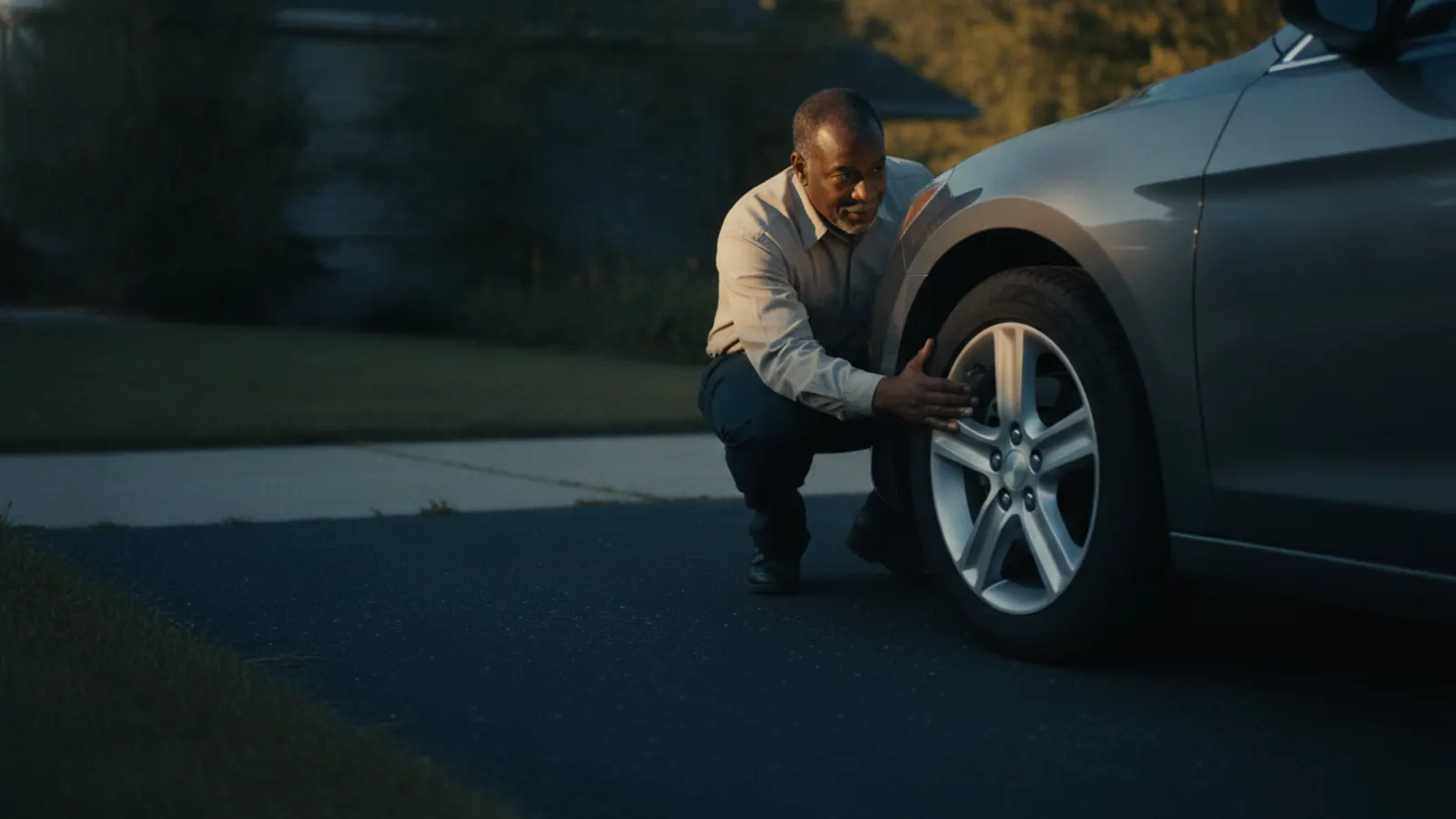
The tyres are worth more of your attention than everything else on the car put together, and they are easiest to judge before they have been driven on.
Pressure first. The Highway Code’s instruction is to check weekly, before the journey, while the tyres are cold, because warm tyres give a misleading reading. The reason this matters is not fuel economy. NHTSA’s study of tyre factors in the phase before a crash found that among tyres underinflated by more than a quarter of the recommended pressure, about a tenth were on vehicles that experienced a tyre problem in the pre-crash phase, against a much smaller share of correctly inflated tyres — a threefold difference in how often the tyre was cited as a critical event. The study is honest that underinflation is not the only cause of tyre problems, and it carries a caveat worth keeping in view: tyre-pressure monitoring had only just become mandatory when the data was collected, so almost none of the surveyed vehicles had it.
Tread next, and measured rather than eyeballed. In the United Kingdom the legal floor is written into the Construction and Use Regulations as at least 1.6 mm across the central three-quarters of the tread around the whole circumference, and Spain’s traffic authority states the same figure while adding that it is unwise to let tyres get that far. The NHTSA study puts a number on why: around a quarter of tyres in the lowest tread band were on vehicles with a tyre problem before the crash, against roughly a twelfth of tyres with a little more tread left. Nothing in the legal minimum promises wet grip. European type approval sets a minimum wet-grip index for a tyre when it is new; it says nothing about the same tyre four winters later.
Then the lights, the glass and the ground under the car. The Highway Code requires lights, indicators, reflectors and number plates to be kept clean and clear and headlights to be properly adjusted so they do not dazzle, and windscreens and windows to be free from obstructions to vision. Spain’s DGT notes drily that a blown headlamp carries a fine. Headlights are also the one item on this list with a clean crash number attached, though it belongs to the lamp and not to the cleaning: the Insurance Institute for Highway Safety found good-rated headlight systems associated with a nineteen percent lower rate of night-time single-vehicle crashes than poor-rated ones, across tens of thousands of crashes. That is a fact about how a car was designed, which you learn when you buy it and cannot change afterwards. What you can change is whether the lenses are dirty and whether both of them work.
A puddle under a parked car is information. So is the level in the reservoirs, which the Highway Code says to check at least weekly, adding the sentence that explains why it is on the list at all: low brake fluid may result in brake failure and a crash.
The first hundred metres
The brakes report on themselves as soon as you use them, and the vocabulary is worth knowing because it maps onto what a workshop will find.
A pedal that goes further than it used to, or sinks slowly while you hold it at a stop, is a hydraulic symptom rather than a wear symptom. The MOT inspection manual classifies a leaking master cylinder and a damaged or excessively corroded brake pipe as serious defects for exactly this reason, and low fluid in the reservoir with nothing visibly leaking usually means the fluid went into the pads as they wore. Either way it is the same day’s job, not next month’s.
A car that pulls to one side under braking is telling you the two sides are not doing equal work — a sticking caliper, a contaminated pad, an uneven tyre. Grinding is past the warning stage: the MOT manual treats a pad worn down to its wear indicator as a major defect and a pad worn below 1.5 mm as a dangerous one, and the noise arrives somewhere in between. A squeal on a cold damp morning that disappears after a few stops is usually surface rust and not the same thing.
The steering and the wipers report in the same stretch. A wiper that smears rather than clears is a visibility defect with a fixed cost and a two-minute fix, and the DGT’s advice on wipers is simply to replace them as soon as they lose effectiveness rather than at an interval.
At speed, and at night
Some faults only appear under load. A vibration through the wheel at a particular speed, a shudder felt through the pedal in a hard stop, a car that wanders on a straight road — all of these are the first honest information you get about wheels, discs and geometry, and all of them are easy to file away as normal because they arrive gradually.
Night is its own inspection. Driving the same familiar road in the dark tells you whether your beam pattern still reaches where it used to, whether one lamp has gone yellow, and whether the windscreen that looked clean in daylight is scattering every oncoming headlight into a haze. Interior glass gets dirty slowly and nobody notices until they are driving into low sun or oncoming traffic.
The check nothing on the road will tell you
Rubber ages whether or not it is used, and the car cannot report this. The date of manufacture is moulded into the sidewall. Michelin’s own guidance is that tyres should be inspected annually by a professional after five years in service and replaced ten years after the date of manufacture regardless of remaining tread or apparent condition. Britain’s standards agency has turned the same concern into a rule for one category of vehicle, prohibiting tyres more than ten years old on the front steered axle of a minibus. A caravan or a second car with plenty of tread and a fifteen-year-old date code is the common case, and it looks perfect.
And the coolant question
Coolant is where a preparedness habit and a postponed repair look identical from outside the car.
A bottle in the boot is a reasonable thing to carry on a long drive in a car that is known to use a small amount between services. What it must not become is the reason a leak never gets fixed. A sealed system that needs topping up every few weeks is losing coolant somewhere, and the same weekly check that the Highway Code asks for is what distinguishes a slow, stable, known consumption from a loss that is getting worse. The honest test is whether you know the rate. If you are topping up without knowing how often you did it last time, the bottle is not preparation.
For a fleet, the same checks become a record
What a driver does by habit, a company has to be able to prove. In the United States the federal rules make the driver’s pre-trip duty explicit: be satisfied the vehicle is in safe operating condition, review the last inspection report where one is required, and sign it to acknowledge the review and the certification that repairs were made. The report itself has to cover a named set of parts — service and parking brakes, steering, lighting devices and reflectors, tyres, horn, wipers, mirrors, coupling devices, wheels and rims, emergency equipment — which is as good a spine for any company’s check sheet as anything a consultant will sell. In Britain, the walkaround guidance states the same principle in one sentence — the driver is responsible for making sure the vehicle is safe to drive — and adds the part that fleets get wrong, which is that defects are reported in writing to the person responsible for fixing them.
The failure mode in a fleet is not that checks are not done. It is that they are done and not recorded, or recorded and not routed to anyone who can authorise a repair. A signed check sheet with a defect on it and no closing entry is worse than no sheet at all, because it proves the company knew.
What the numbers do and do not support
The statistic that gets quoted against everything above is NHTSA’s national crash causation survey, which assigned the critical reason to the driver in ninety-four percent of crashes and to a vehicle component’s failure or degradation in about two percent. Anyone using it to argue that maintenance is marginal is arguing against the study’s own text. It states that the critical reason is not to be read as the cause of the crash, and it states that no vehicle received a detailed inspection — the vehicle-related reasons were inferred from looking at cars externally, so only visible items were ever cited, and the authors write that the resulting statistics may not be representative of internal problems that led to crashes. Within that two percent, tyres and wheels account for the largest share and brakes the next largest, with confidence intervals wide enough that the ordering is the finding and the figures are not.
Which is roughly what a driver would guess. The parts of a car that fail visibly are the parts a driver can check.
What we cannot tell you
We cannot tell you how much a given check reduces your own risk, because the studies that exist measure populations and not people, and the honest ones say so. We cannot tell you when your pads need replacing without measuring them. And we cannot tell you how a defect will be treated if it turns out to have contributed to a crash — whether knowing about it and driving anyway affects what you recover is a question of the negligence rule where you are, which is in the data below.
The two minutes before a long drive
Walk round the car. Look at each tyre from the front rather than from above, look for a shine or a ridge on the inner or outer shoulder, and put a gauge on them if they have not been checked this week. Look at the ground where the car has been standing. Switch the lights on and walk round again, including the indicators and the brake lights with someone behind the car or a reflection to watch. Clean the glass inside as well as outside, and fill the washer bottle. Then, in the first quiet stretch of road, brake once, deliberately, harder than you need to, and pay attention to what the car does.
None of that finds everything. It finds the things that would otherwise find you at the worst moment, which is a lower standard and a useful one.
Rules in your jurisdiction
Deadlines, fault rules and minimum coverage differ by state and country. Pick yours to see the rules that apply to this topic.
Select a jurisdiction to see its rules.
| Shared-fault rule | Contributory negligence Contributory negligence is “an affirmative and complete defense” in Alabama, with no apportionment: a claimant found negligent at all recovers nothing. Whether they were is normally a jury question, becoming one of law “only when the facts are such that all reasonable men must draw the same conclusion”. Two qualifications matter — a passenger is not sunk by the driver’s fault, and failing to wear a seat belt “shall not be considered evidence of contributory negligence” (Ala. Code § 32-5B-7). |
|---|---|
| Regulator | Alabama Department of Insurance |
Verified as ofSeptember 15, 2026 · Car insurance claims in Alabama →
| Shared-fault rule | Pure comparative negligence Alaska’s shared-fault rule is one sentence long and contains no percentage and no bar of any kind: «In an action based on fault seeking to recover damages for injury or death to a person or harm to property, contributory fault chargeable to the claimant diminishes proportionately the amount awarded as compensatory damages for the injury attributable to the claimant’s contributory fault, but does not bar recovery» (§ 09.17.060, from § 1 ch 139 SLA 1986). «But does not bar recovery» is the whole rule, so a claimant ninety per cent to blame still recovers a tenth. The machinery is prescribed as well: the court «shall instruct the jury to answer special interrogatories» stating «the amount of damages each claimant would be entitled to recover if contributory fault is disregarded» and «the percentage of the total fault that is allocated to each claimant, defendant, third-party defendant, person who has been released from liability, or other person responsible», with the trier of fact directed to weigh «both the nature of the conduct of each person at fault, and the extent of the causal relation between the conduct and the damages claimed» (§ 09.17.080(a)–(b)). ALASKA HAS ABOLISHED JOINT LIABILITY, AND THAT IS THE CONSEQUENCE A CLAIMANT MUST PLAN FOR: «The court shall enter judgment against each party liable on the basis of several liability in accordance with that party’s percentage of fault» (§ 09.17.080(d)), so a claimant who sues one of two at-fault drivers collects that driver’s share and no more, and fault is allocated to settled and released persons too. The apportionment also runs on a statutory definition of fault that is wider than negligence: «“fault” includes acts or omissions that are in any measure negligent, reckless, or intentional … The term also includes breach of warranty, unreasonable assumption of risk not constituting an enforceable express consent, misuse of a product …, and unreasonable failure to avoid an injury or to mitigate damages» (§ 09.17.900) — so a claimant’s own conduct after the crash is apportionable, not merely their driving. |
|---|---|
| Regulator | Alaska Division of Insurance, Department of Commerce, Community, and Economic Development |
Verified as ofSeptember 11, 2026 · Car insurance claims in Alaska →
| Shared-fault rule | Pure comparative negligence Where two or more people are at fault, «the liability to make good the damage or loss is in proportion to the degree in which each person was at fault but if, having regard to all the circumstances of the case, it is not possible to establish different degrees of fault, the liability shall be apportioned equally», and nothing renders a person liable for loss «to which the person’s fault has not contributed» (Contributory Negligence Act, s. 1). Vehicle-damage recovery from your own insurer is instead scaled by the prescribed fault determination rules (Insurance Act, s. 585.1(4)). |
|---|---|
| Regulator | Government of Alberta — automobile insurance |
Verified as ofSeptember 10, 2026 · Car insurance claims in Alberta →
| Shared-fault rule | Pure comparative negligence Liability for damage caused by the circulation of vehicles is objective (strict) — Código Civil y Comercial arts. 1757 and 1769 — and «puede ser excluida o limitada por la incidencia del hecho del damnificado en la producción del daño» (art. 1729): the victim’s own act reduces, or in an extreme case excludes, the award. |
|---|---|
| Regulator | Superintendencia de Seguros de la Nación (SSN) |
Verified as ofSeptember 10, 2026 · Car insurance claims in Argentina →
| Shared-fault rule | Pure comparative negligence Contributory negligence and assumption of risk reduce, never bar: «the claimant’s action is not barred, but the full damages shall be reduced in proportion to the relative degree of the claimant’s fault which is a proximate cause of the injury or death». No percentage threshold appears anywhere in the section; the single exception is conduct rather than a figure, since there is no right to comparative negligence «in favor of any claimant who has intentionally, wilfully or wantonly caused or contributed to the injury or wrongful death» (A.R.S. § 12-2505(A)). |
|---|---|
| Regulator | Arizona Department of Insurance and Financial Institutions (DIFI) |
Verified as ofSeptember 10, 2026 · Car insurance claims in Arizona →
| Shared-fault rule | Pure comparative negligence In the actions that survive — vehicle damage, and the narrow injury exceptions — liability «is in proportion to the degree to which each person was at fault», is «apportioned equally» where it is not possible to establish different degrees, and never reaches loss to which a person’s fault did not contribute (Negligence Act, s. 1). The Act’s definitions include proceedings in the Civil Resolution Tribunal, where many vehicle-damage disputes are actually decided. |
|---|---|
| Regulator | BC Financial Services Authority (BCFSA) |
Verified as ofSeptember 10, 2026 · Car insurance claims in British Columbia →
| Shared-fault rule | Not yet verified |
|---|---|
| Regulator | California Department of Insurance |
Verified as ofSeptember 10, 2026 · Car insurance claims in California →
| Shared-fault rule | Pure comparative negligence «La apreciación del daño está sujeta a reducción, si el que lo ha sufrido se expuso a él imprudentemente» — the award is reduced where the victim imprudently exposed themselves to the harm (Código Civil art. 2330). |
|---|---|
| Regulator | Comisión para el Mercado Financiero (CMF) |
Verified as ofSeptember 10, 2026 · Car insurance claims in Chile →
| Shared-fault rule | Pure comparative negligence «La apreciación del daño está sujeta a reducción, si el que lo ha sufrido se expuso a él imprudentemente» — the award is reduced where the victim imprudently exposed themselves to the harm (Código Civil art. 2357); no threshold bars recovery. |
|---|---|
| Regulator | Superintendencia Financiera de Colombia |
Verified as ofSeptember 10, 2026 · Car insurance claims in Colombia →
| Shared-fault rule | Modified comparative (50% bar) Colorado bars at exactly half. Recovery survives only «if such negligence was not as great as the negligence of the person against whom recovery is sought», and where the claimant’s proportion «is equal to or greater than the negligence of the person against whom recovery is sought, then, in such event, the court shall enter a judgment for the defendant» (C.R.S. § 13-21-111(1), (3)). A claimant found exactly 50 % responsible recovers nothing. |
|---|---|
| Regulator | Colorado Division of Insurance |
Verified as ofSeptember 11, 2026 · Car insurance claims in Colorado →
| Shared-fault rule | Modified comparative (51% bar) Contributory negligence «shall not bar recovery … if the negligence was not greater than the combined negligence of the person or persons against whom recovery is sought», settled or released persons included, and damages «shall be diminished in the proportion of the percentage of negligence attributable to the person recovering» (Conn. Gen. Stat. § 52-572h(b)). The comparison is against everyone sued added together, not against any one defendant, and a claimant at exactly 50 % still recovers half. |
|---|---|
| Regulator | Connecticut Insurance Department |
Verified as ofSeptember 11, 2026 · Car insurance claims in Connecticut →
| Shared-fault rule | Modified comparative (51% bar) Delaware’s comparative statute is one sentence and the bar bites only ABOVE the defendant’s share: «In all actions brought to recover damages for negligence which results in death or injury to person or property, the fact that the plaintiff may have been contributorily negligent shall not bar a recovery by the plaintiff … where such negligence was not greater than the negligence of the defendant or the combined negligence of all defendants against whom recovery is sought, but any damages awarded shall be diminished in proportion to the amount of negligence attributed to the plaintiff» (§ 8132, from 64 Del. Laws, c. 384, § 1; 70 Del. Laws, c. 186, § 1). «Not greater than» is the 51 % form, so A CRASH APPORTIONED FIFTY-FIFTY IN DELAWARE STILL RECOVERS HALF — the same shape as Iowa, West Virginia and Hawaii, and the opposite of Kansas and Nebraska, where an equal share recovers nothing. Note the denominator: the comparison is against «the combined negligence of all defendants against whom recovery is sought», not against each defendant separately, which changes the outcome in a multi-defendant crash and which no summary states. |
|---|---|
| Regulator | Delaware Department of Insurance |
Verified as ofSeptember 11, 2026 · Car insurance claims in Delaware →
| Shared-fault rule | Contributory negligence Between drivers the District keeps the old bar: “a plaintiff in a negligence action generally cannot recover when he or she is found to have been contributorily negligent” (Asal v. Estate of Mina, 247 A.3d 260, 271 (D.C. 2021)). Two things soften it. Last clear chance survives, so a contributorily negligent claimant may still recover where the defendant had the final opportunity to avoid the collision. And § 50-2204.52 carves out pedestrians and “vulnerable users” — a defined term that includes cyclists, scooter riders and motorcyclists, but not the driver or occupant of a car — who are barred only if their negligence was a proximate cause and greater than the aggregated total negligence of all the defendants. |
|---|---|
| Regulator | District of Columbia Department of Insurance, Securities and Banking |
Verified as ofSeptember 15, 2026 · Car insurance claims in District of Columbia →
| Shared-fault rule | Not yet verified |
|---|---|
| Regulator | Superintendencia de Seguros de la República Dominicana |
Verified as ofSeptember 10, 2026 · Car insurance claims in Dominican Republic →
| Shared-fault rule | Pure comparative negligence Contributory negligence: damages are reduced «to such extent as the court thinks just and equitable having regard to the claimant’s share in the responsibility for the damage» (Law Reform (Contributory Negligence) Act 1945, s. 1(1)). |
|---|---|
| Regulator | Financial Conduct Authority (conduct) · Financial Ombudsman Service (complaints) |
Verified as ofSeptember 10, 2026 · Car insurance claims in England and Wales →
| Shared-fault rule | Modified comparative (51% bar) In a negligence action «any party found to be greater than 50 percent at fault for his or her own harm may not recover any damages»; below that, damages are reduced in proportion (Fla. Stat. § 768.81(2), (6), as amended by ch. 2023-15). |
|---|---|
| Regulator | Florida Office of Insurance Regulation (regulation) · Department of Financial Services, Division of Consumer Services (complaints) |
Verified as ofSeptember 10, 2026 · Car insurance claims in Florida →
| Shared-fault rule | Modified comparative (51% bar) Past the tort threshold, shared fault is handled by a 1969 statute that has not been amended since 1976: «Contributory negligence shall not bar recovery in any action by any person … to recover damages for negligence resulting in death or in injury to person or property, if such negligence was not greater than the negligence of the person or in the case of more than one person, the aggregate negligence of such persons against whom recovery is sought, but any damages allowed shall be diminished in proportion to the amount of negligence attributable to the person for whose injury, damage or death recovery is made» (§ 663-31(a)). «Not greater than» is the 51 % form, so a crash apportioned fifty-fifty still recovers half, and the comparison is against the AGGREGATE negligence of everyone sued rather than against each defendant. The mechanics are prescribed as well as the rule: in a jury trial the jury «shall return a special verdict» stating the damages that would have been recoverable absent contributory negligence and «the degree of negligence of each party, expressed as a percentage»; the court then reduces the award proportionally, and enters judgment for the defendant where the claimant’s proportion is greater than the aggregate negligence of those sued (§ 663-31(b)–(c)). «The court shall instruct the jury regarding the law of comparative negligence where appropriate» (§ 663-31(d)). |
|---|---|
| Regulator | Hawaii Insurance Division, Department of Commerce and Consumer Affairs |
Verified as ofSeptember 11, 2026 · Car insurance claims in Hawaii →
| Shared-fault rule | Modified comparative (50% bar) Idaho’s bar bites at equality, not above it: «Contributory negligence or comparative responsibility shall not bar recovery in an action by any person … to recover damages for negligence, gross negligence or comparative responsibility resulting in death or in injury to person or property, if such negligence or comparative responsibility was NOT AS GREAT AS the negligence, gross negligence or comparative responsibility of the person against whom recovery is sought, but any damages allowed shall be diminished in the proportion to the amount of negligence or comparative responsibility attributable to the person recovering» (§ 6-801). «Not as great as» is the 50 % form in this dataset’s convention, so A CRASH APPORTIONED FIFTY-FIFTY IN IDAHO RECOVERS NOTHING. BUT THE PERCENTAGE ALONE IS MISLEADING, AND § 6-803(3) IS THE SENTENCE A SUMMARY ALWAYS DROPS. Note first that § 6-801 compares the claimant against «the person against whom recovery is sought», singular. Section 6-803(3) then says how that is done: «The common law doctrine of joint and several liability is hereby limited to causes of action listed in subsection (5) of this section. In any action in which the trier of fact attributes the percentage of negligence or comparative responsibility to persons listed on a special verdict, the court shall enter a separate judgment against each party whose negligence or comparative responsibility exceeds the negligence or comparative responsibility attributed to the person recovering. The negligence or comparative responsibility of each such party is to be compared INDIVIDUALLY to the negligence or comparative responsibility of the person recovering», and judgment against each is «in an amount equal to each party’s proportionate share». So a claimant 30 % at fault against two defendants at 35 % each recovers from both, while A CLAIMANT 40 % AT FAULT AGAINST TWO DEFENDANTS AT 30 % EACH RECOVERS FROM NEITHER — even though the defendants together were more at fault than the claimant. Joint and several liability survives only «where they were acting in concert or when a person was acting as an agent or servant of another party», and «acting in concert» means «pursuing a common plan or design which results in the commission of an intentional or reckless tortious act» (§ 6-803(5)). The apportioning special verdict is discretionary for the court but mandatory once asked for: the court «may, and when requested by any party shall, direct the jury to find separate special verdicts», and the reduction is then the court’s arithmetic duty rather than the jury’s (§ 6-802) — a softer rule than Hawaii’s § 663-31(b), which requires the special verdict outright. |
|---|---|
| Regulator | Idaho Department of Insurance |
Verified as ofSeptember 11, 2026 · Car insurance claims in Idaho →
| Shared-fault rule | Modified comparative (51% bar) The plaintiff is barred «if the trier of fact finds that the contributory fault on the part of the plaintiff is more than 50% of the proximate cause»; otherwise damages are «diminished in the proportion to the amount of fault attributable to the plaintiff» (735 ILCS 5/2-1116). |
|---|---|
| Regulator | Illinois Department of Insurance |
Verified as ofSeptember 10, 2026 · Car insurance claims in Illinois →
| Shared-fault rule | Modified comparative (51% bar) Contributory fault «diminishes proportionately the amount awarded as compensatory damages … but does not bar recovery except as provided in section 6», and section 6 bars the claim where the claimant’s fault «is greater than the fault of all persons whose fault proximately contributed to the claimant’s damages» (Ind. Code §§ 34-51-2-5, 34-51-2-6). The jury instruction puts it in figures — above 50 % the claim fails, at exactly 50 % the claimant recovers half (§ 34-51-2-8(b)(2)–(3)) — and the comparison includes nonparties, so a share allocated to somebody who was never sued still counts against the claimant. |
|---|---|
| Regulator | Indiana Department of Insurance |
Verified as ofSeptember 11, 2026 · Car insurance claims in Indiana →
| Shared-fault rule | Modified comparative (51% bar) Reduction, not a bar, until the claimant carries more than everyone else put together: «Contributory fault shall not bar recovery in an action by a claimant to recover damages for fault resulting in death or in injury to person or property unless the claimant bears a greater percentage of fault than the combined percentage of fault attributed to the defendants, third-party defendants and persons who have been released pursuant to section 668.7, but any damages allowed shall be diminished in proportion to the amount of fault attributable to the claimant» (§ 668.3(1)(a)). «Greater than» is the 51 % form, so a driver exactly half to blame still recovers half — the opposite of Kansas and Nebraska next door. The comparison is against the combined fault of all the defendants and released parties, not against each of them separately. A consortium claim is measured differently again: it is barred by the fault of the injured person, not of the family member bringing it (§ 668.3(1)(b)). Do not confuse either rule with § 668.4, which is a separate fifty-percent rule about joint and several liability among defendants. |
|---|---|
| Regulator | Iowa Insurance Division |
Verified as ofSeptember 11, 2026 · Car insurance claims in Iowa →
| Shared-fault rule | Modified comparative (50% bar) Kansas is one of the strict states, and the wording is what makes it strict: «The contributory negligence of a party in a civil action does not bar that party or its legal representative from recovering damages for negligence resulting in death, personal injury, property damage or economic loss, if that party’s negligence was less than the causal negligence of the party or parties against whom a claim is made, but the award of damages to that party must be reduced in proportion to the amount of negligence attributed to that party» (§ 60-258a(a)). «Less than» is the 50 % form: A CRASH APPORTIONED EXACTLY FIFTY-FIFTY RECOVERS NOTHING IN KANSAS — the opposite of Iowa, which sits on the other side of the same round with a «greater than» bar. In a wrongful-death claim the decedent’s own negligence is imputed to the person claiming. Joint and several liability does not survive a comparative-negligence case: «each party is liable for that portion of the total dollar amount awarded as damages to a claimant in the proportion that the amount of that party’s causal negligence bears to the amount of the causal negligence attributed to all parties» (§ 60-258a(d)). |
|---|---|
| Regulator | Kansas Department of Insurance |
Verified as ofSeptember 11, 2026 · Car insurance claims in Kansas →
| Shared-fault rule | Pure comparative negligence KRS 411.182 apportions fault into «each party’s equitable share of the obligation to each claimant in accordance with the respective percentages of fault», weighing both the nature of each party’s conduct and the extent of the causal relation between that conduct and the damages. Subsections (1) to (4) were read end to end and contain no percentage threshold, no bar and no «greater than fifty percent» clause, so nothing defeats a claimant at any percentage. |
|---|---|
| Regulator | Kentucky Department of Insurance |
Verified as ofSeptember 11, 2026 · Car insurance claims in Kentucky →
| Shared-fault rule | Modified comparative (51% bar) From 1 January 2026 a claimant whose own negligence is «equal to or greater than fifty-one percent» recovers nothing, and below that the award is reduced in proportion (C.C. art. 2323(A)(2)(a)–(b), as amended by Acts 2025, No. 15, eff. 1 Jan. 2026). The bar sits at 51 %, not at «greater than 50 %»: a claimant exactly 51 % at fault recovers nothing, one at 50.9 % recovers 49.1 %. Louisiana was a pure comparative-fault state from 1979 until 31 December 2025, and the act’s own title says it is passed «to establish a modified comparative fault system». Whether the 51 % bar reaches accidents before 1 January 2026 has not yet been verified against a primary text and is not stated here — the act fixes an effective date and says nothing else. |
|---|---|
| Regulator | Louisiana Department of Insurance |
Verified as ofSeptember 11, 2026 · Car insurance claims in Louisiana →
| Shared-fault rule | Modified comparative (50% bar) MAINE’S SHARED-FAULT RULE IS UNLIKE ANY OTHER IN THIS DATASET AND MUST NOT BE FLATTENED INTO A PERCENTAGE — THE LABEL «modified-50» CARRIES THE BAR AND NOTHING ELSE, BECAUSE THE STATUTE PROMISES NO PROPORTIONAL ARITHMETIC AT ALL. «When any person suffers death or damage as a result partly of that person’s own fault and partly of the fault of any other person or persons, a claim in respect of that death or damage MAY NOT BE DEFEATED BY REASON OF THE FAULT OF THE PERSON SUFFERING THE DAMAGE, BUT THE DAMAGES RECOVERABLE IN RESPECT THEREOF MUST BE REDUCED TO SUCH EXTENT AS THE JURY THINKS JUST AND EQUITABLE HAVING REGARD TO THE CLAIMANT’S SHARE IN THE RESPONSIBILITY FOR THE DAMAGE. … the court shall instruct the jury to find and record the total damages that would have been recoverable if the claimant had not been at fault, AND FURTHER INSTRUCT THE JURY TO REDUCE THE TOTAL DAMAGES BY DOLLARS AND CENTS, AND NOT BY PERCENTAGE, to the extent considered just and equitable …, and instruct the jury to return both amounts WITH THE KNOWLEDGE THAT THE LESSER FIGURE IS THE FINAL VERDICT in the case. … “Fault” means negligence, breach of statutory duty or other act or omission that gives rise to a liability in tort … IF SUCH CLAIMANT IS FOUND BY THE JURY TO BE EQUALLY AT FAULT, THE CLAIMANT MAY NOT RECOVER» (14 M.R.S. § 156). So TWO THINGS ARE TRUE AT ONCE AND BOTH MATTER. The bar is at equality — a claimant found EQUALLY at fault recovers nothing, so a fifty-fifty crash in Maine recovers nothing, the same outcome as Idaho, Kansas, Nebraska and North Dakota. But between zero and equal fault the reduction is whatever the jury thinks just and equitable, expressed IN DOLLARS AND CENTS AND EXPRESSLY NOT AS A PERCENTAGE, with the jury returning the gross figure and the reduced figure and the lesser one entering as the verdict. A READER TOLD «MAINE IS MODIFIED COMPARATIVE AT 50 %» WILL EXPECT A CLAIMANT 30 % AT FAULT TO LOSE EXACTLY 30 %, AND MAINE’S STATUTE DOES NOT PROMISE THAT. The multi-defendant rule points the opposite way from Idaho’s: «In a case involving multiparty defendants, EACH DEFENDANT IS JOINTLY AND SEVERALLY LIABLE TO THE PLAINTIFF FOR THE FULL AMOUNT OF THE PLAINTIFF’S DAMAGES. However, any defendant has the right through the use of special interrogatories to request of the jury the percentage of fault contributed by each defendant.» So Maine keeps joint and several liability in full — a solvent defendant can be made to pay everything — and percentages between defendants are found only if a defendant asks for them, where Idaho’s § 6-803(3) abolishes joint liability outside concert and agency. The price is the settlement machinery: releasing one defendant under an agreement that precludes collecting its share entitles it to be «dismissed with prejudice», bars contribution claims against it, and leaves the remaining parties to conduct discovery and invoke the evidentiary rules «as if the released and dismissed defendant were still a party» (§ 156(1)–(2)). |
|---|---|
| Regulator | Maine Bureau of Insurance, Department of Professional and Financial Regulation |
Verified as ofSeptember 11, 2026 · Car insurance claims in Maine →
| Shared-fault rule | Pure comparative negligence Contributory negligence «is not a bar to the recovery of damages», and where the plaintiff’s negligence contributed «the court shall apportion the damages in proportion to the degree of negligence found against the plaintiff and defendant respectively» (Tortfeasors and Contributory Negligence Act, s. 4); where apportionment is not practicable the parties «shall be deemed equally negligent» (s. 6). Because injury actions are abolished, the rule does its work on property damage. |
|---|---|
| Regulator | Manitoba Public Insurance (MPI) |
Verified as ofSeptember 10, 2026 · Car insurance claims in Manitoba →
| Shared-fault rule | Contributory negligence Maryland keeps the common-law contributory-negligence bar, and there is no percentage to publish: a claimant the fact-finder finds negligent recovers nothing, with no apportionment. The Court of Appeals declined to abandon the doctrine in 2013 — «although this Court has the authority to change the common law rule of contributory negligence, we decline to abrogate Maryland’s long-established common law principle of contributory negligence» — and described the effect in the case before it: «Because of the contributory negligence finding, Coleman was barred from any recovery» (Coleman v. Soccer Association of Columbia, 432 Md. 679 (2013)). One statutory carve-out matters in a motor claim: failure to wear a seat belt may not «be considered evidence of contributory negligence», may not limit a party’s or an insurer’s liability, and may not be referred to at trial (Transportation § 22-412.3(h)). |
|---|---|
| Regulator | Maryland Insurance Administration |
Verified as ofSeptember 10, 2026 · Car insurance claims in Maryland →
| Shared-fault rule | Modified comparative (51% bar) Contributory negligence «shall not bar recovery … if such negligence was not greater than the total amount of negligence attributable to the person or persons against whom recovery is sought», and damages are «diminished in proportion» to it; assumption of risk is abolished and the claimant «shall be presumed to have been in the exercise of due care» (M.G.L. c. 231, § 85). |
|---|---|
| Regulator | Massachusetts Division of Insurance |
Verified as ofSeptember 10, 2026 · Car insurance claims in Massachusetts →
| Shared-fault rule | Not yet verified Not settled on the texts read. The only shared-fault provision in the federal civil code is an all-or-nothing defence: the defendant escapes liability by proving the harm followed from «culpa o negligencia inexcusable de la víctima» (Código Civil Federal arts. 1910 and 1913), which is a complete answer and not a percentage reduction. Ordinary crash liability is in any case governed by the 32 state civil codes, because the federal code applies only to federal matters (art. 1º); whether a state court reduces an award for a victim’s ordinary negligence has not yet been verified against a primary text and is not stated here. |
|---|---|
| Regulator | CONDUSEF — Comisión Nacional para la Protección y Defensa de los Usuarios de Servicios Financieros |
Verified as ofSeptember 10, 2026 · Car insurance claims in Mexico →
| Shared-fault rule | Modified comparative (51% bar) Damages are reduced by the claimant’s share of fault, and where that share «is greater than the aggregate fault of the other person or persons» the court «shall reduce economic damages by the percentage of comparative fault … and noneconomic damages shall not be awarded» (MCL 600.2959) — so only noneconomic damages are barred, and economic damages survive pro rata. Inside the no-fault chapter itself, «damages must not be assessed in favor of a party who is more than 50% at fault», and none are assessed in favour of a party driving without the statutory security (MCL 500.3135(2)(b)–(c)). |
|---|---|
| Regulator | Michigan Department of Insurance and Financial Services (DIFS) |
Verified as ofSeptember 10, 2026 · Car insurance claims in Michigan →
| Shared-fault rule | Modified comparative (50% bar) Contributory fault does not bar recovery if it was “not greater than the fault of the person against whom recovery is sought”, so a claimant at exactly 50 % still recovers half; above that the claim is barred. Last clear chance is abolished by statute (§ 604.01, subds. 1 and 1a). |
|---|---|
| Regulator | Minnesota Department of Commerce |
Verified as ofSeptember 15, 2026 · Car insurance claims in Minnesota →
| Shared-fault rule | Not yet verified Missouri’s shared-fault rule for an ordinary collision is judge-made, and it is not published as a value here. § 537.765, often cited for it, abolishes the contributory-fault bar and applies «the doctrine of pure comparative fault» expressly and only «in a products liability claim», so it does not reach a crash. Federal opinions published by the Government Publishing Office characterise Gustafson v. Benda, 661 S.W.2d 11 (Mo. 1983) (en banc) as having adopted pure comparative fault, but the Missouri Supreme Court’s own text could not be read and that characterisation is not a verified reading of it. What statute does fix is the defendants’ side: in all tort actions a defendant at fifty-one percent or more of the fault is jointly and severally liable for the whole judgment, and one below that share pays only its own percentage (§ 537.067.1) — a rule about defendants, not a bar on the claimant. |
|---|---|
| Regulator | Missouri Department of Commerce and Insurance |
Verified as ofSeptember 11, 2026 · Car insurance claims in Missouri →
| Shared-fault rule | Modified comparative (51% bar) Montana’s bar bites only ABOVE fifty per cent, and the section carries TWO texts, each labelled by the publisher, of which the operative one is the one marked «(Temporary)». «27-1-702. (Temporary) Comparative negligence — extent to which contributory negligence bars recovery in action for damages. Contributory negligence does not bar recovery in an action by a person … to recover damages for negligence resulting in death or injury to the person or property IF THE CONTRIBUTORY NEGLIGENCE WAS NOT GREATER THAN THE NEGLIGENCE OF THE PERSON OR THE COMBINED NEGLIGENCE OF ALL PERSONS AGAINST WHOM RECOVERY IS SOUGHT, but any damages allowed MUST BE DIMINISHED IN THE PROPORTION TO THE PERCENTAGE OF NEGLIGENCE ATTRIBUTABLE TO THE PERSON RECOVERING. (Terminates on occurrence of contingency--sec. 11(2), Ch. 429, L. 1997.)» «Not greater than» is the 51 % form in this dataset’s convention, so A CRASH APPORTIONED FIFTY-FIFTY IN MONTANA RECOVERS HALF — the same camp as Iowa, West Virginia, Hawaii, Vermont and Wyoming, and the opposite of Idaho, Kansas, Nebraska, Maine and North Dakota. Note also that the denominator is the COMBINED negligence of all the persons sued, which helps a claimant facing several defendants, and that the reduction here IS proportional and by percentage — unlike Maine’s § 156, which forbids a percentage reduction. TWO THINGS ABOUT THE LABELS MUST BE GOT RIGHT AND NEITHER MAY BE AVERAGED AWAY. FIRST, «TEMPORARY» DOES NOT MEAN SHORT-LIVED: this text terminates only on a contingency fixed by section 11(2) of chapter 429 of the Laws of 1997, and that contingency has not occurred — so the «(Temporary)» text is the law, and a secondary description will quote whichever of the two it happens to have copied. SECOND, THE CONTINGENT SUCCESSOR TEXT WOULD CHANGE THE DENOMINATOR AND COULD DEFEAT A CLAIMANT THE PRESENT TEXT ALLOWS TO RECOVER: «27-1-702. (Effective on occurrence of contingency) Comparative fault … if the contributory fault was not greater than the fault of the defendant OR THE COMBINED FAULT OF ALL DEFENDANTS AND NONPARTIES» — adding non-parties to the comparison, which is materially wider. The contingency itself was not opened, so what is published is the operative text with the pending alternative disclosed beside it. |
|---|---|
| Regulator | Montana Commissioner of Securities and Insurance |
Verified as ofSeptember 11, 2026 · Car insurance claims in Montana →
| Shared-fault rule | Modified comparative (50% bar) Nebraska reaches Kansas’s strict result through different words: «Any contributory negligence chargeable to the claimant shall diminish proportionately the amount awarded as damages for an injury attributable to the claimant’s contributory negligence but shall not bar recovery, except that if the contributory negligence of the claimant is equal to or greater than the total negligence of all persons against whom recovery is sought, the claimant shall be totally barred from recovery» (§ 25-21,185.09). «Equal to or greater than» is the 50 % form: A CRASH APPORTIONED EXACTLY FIFTY-FIFTY RECOVERS NOTHING IN NEBRASKA, and the comparison is against the TOTAL negligence of everyone sued, not against each defendant. The same section gives a procedural right worth knowing: «The jury shall be instructed on the effects of the allocation of negligence.» One regulation exists because the bar is otherwise a bargaining weapon: «Insurers shall not assign a percentage of negligence to a claimant for the purpose of reducing a settlement, when there exists no reasonable evidence upon which the assigned percentage of negligence could be based» (210 Neb. Admin. Code ch. 60, § 008.06) — found in no other state’s claims rule in this dataset. |
|---|---|
| Regulator | Nebraska Department of Insurance |
Verified as ofSeptember 11, 2026 · Car insurance claims in Nebraska →
| Shared-fault rule | Modified comparative (51% bar) A claimant’s comparative negligence «does not bar a recovery if that negligence was not greater than the negligence or gross negligence of the parties to the action against whom recovery is sought» (NRS 41.141(1)), and where several defendants are sued the comparison is against their combined negligence (NRS 41.141(2)(a)). So a fifty-fifty crash still recovers half. |
|---|---|
| Regulator | Nevada Division of Insurance |
Verified as ofSeptember 11, 2026 · Car insurance claims in Nevada →
| Shared-fault rule | Pure comparative negligence Shared fault reduces a New Brunswick award; it never extinguishes it. «Where by the fault of two or more persons damage or loss is caused to one or more of them, the liability to make good the damage or loss is in proportion to the degree in which each person was at fault but if, having regard to all the circumstances of the case, it is not possible to establish different degrees of fault, the liability shall be apportioned equally», and nothing in that section operates «so as to render any person liable for any damage or loss to which his fault has not contributed» (Contributory Negligence Act, R.S.N.B. 1973, c. C-19, s. 1(1)–(2)). No percentage bars recovery. Where two or more persons are found at fault «they are jointly and severally liable to the person suffering the damage or loss», contributing between themselves in proportion to fault (s. 2(2)) — so a claimant may recover the whole reduced award from one of several at-fault drivers. Fault and its degrees are questions of fact (s. 5), and «unless the judge otherwise directs, the liability for costs of the parties shall be in the same proportion as the liability to make good the loss or damage» (s. 7(2)), which is the practical sting of a partial-fault finding. The text read is the publisher’s consolidation to 1 September 2011. |
|---|---|
| Regulator | New Brunswick Financial and Consumer Services Commission |
Verified as ofSeptember 11, 2026 · Car insurance claims in New Brunswick →
| Shared-fault rule | Modified comparative (51% bar) Contributory negligence does not bar recovery “if such negligence was not greater than the negligence of the person against whom recovery is sought or was not greater than the combined negligence of the persons against whom recovery is sought”, and damages are then “diminished by the percentage sustained of negligence attributable to the person recovering” (N.J.S.A. 2A:15-5.1). Read the words rather than the label: a claimant at exactly 50 % is “not greater than” and recovers; the bar falls at 51 %. The same rule covers damage to the vehicle, because the section reaches negligence “resulting in death or injury to person or property”. |
|---|---|
| Regulator | New Jersey Department of Banking and Insurance |
Verified as ofSeptember 15, 2026 · Car insurance claims in New Jersey →
| Shared-fault rule | Not yet verified NEW MEXICO HAS NO COMPARATIVE-FAULT STATUTE, AND THE FIELD IS «UNCLEAR» FOR A SOURCING REASON RATHER THAN A LEGAL ONE. The rule is judge-made. New Mexico is characterised as a pure comparative-negligence state on the authority of Scott v. Rizzo, 1981-NMSC-021, 96 N.M. 682, 634 P.2d 1234, in which the Supreme Court of New Mexico held that comparative negligence «is adopted in this jurisdiction and replaces the “all-or-nothing” rule of contributory negligence» and that «a pure comparative negligence standard shall supersede prior law in New Mexico, and that a plaintiff suing in negligence shall no longer be totally barred from recovery because of his contributory negligence». That opinion was read in full, with its official citation and panel, at nmonesource.com — the New Mexico Compilation Commission’s platform, the state’s official publisher of the appellate reports — but NOT at a court-operated host, and this dataset only records a judge-made comparative rule as verified when the opinion is read at the court’s own site or at GPO. New Mexico’s courts host was unusable: nmcourts.gov and supremecourt.nmcourts.gov both answer a 302 redirect to 127.0.0.1. So the case is named here as CHARACTERISATION and the enum is left «unclear» rather than asserting a value on a locator the rules of this dataset do not accept. What the Legislature does supply corroborates that no percentage bar exists: it speaks only of «any cause of action to which the doctrine of comparative fault applies» when abolishing joint and several liability, and codifies no threshold (§ 41-3A-1(A)). That abolition matters in its own right — «The liability of any such defendants shall be several», each paying «only for that portion» equal to the ratio of its own fault «to the total fault attributed to all persons, including plaintiffs, defendants and persons not party to the action», so people who are not parties count in the denominator. Four carve-outs restore joint liability, and the fourth is open-ended: intentional injury, vicarious liability, strict product liability, and «situations not covered by any of the foregoing and having a sound basis in public policy» (§ 41-3A-1(C)). |
|---|---|
| Regulator | New Mexico Office of Superintendent of Insurance |
Verified as ofSeptember 11, 2026 · Car insurance claims in New Mexico →
| Shared-fault rule | Pure comparative negligence The claimant’s culpable conduct «shall not bar recovery, but the amount of damages otherwise recoverable shall be diminished in the proportion» it bears to the conduct that caused the damages (C.P.L.R. § 1411). |
|---|---|
| Regulator | New York State Department of Financial Services |
Verified as ofSeptember 10, 2026 · Car insurance claims in New York →
| Shared-fault rule | Pure comparative negligence Shared fault reduces a Newfoundland and Labrador award and never bars it. «Where by the fault of 2 or more persons damage or loss is caused to 1 or more of them, the liability to make good the damage or loss shall be in proportion to the degree in which each person was at fault», and notwithstanding that, «where, having regard to the circumstances of the case, it is not possible to establish different degrees of fault, the liability shall be apportioned equally» and «nothing in this section shall operate so as to make a person liable for damage or loss to which his or her fault has not contributed» (Contributory Negligence Act, R.S.N.L. 1990, c. C-33, s. 2(1)–(2)). No percentage of the claimant’s own fault defeats the claim. Where two or more are found at fault «they shall be jointly and individually liable to the person suffering damage or loss» — the Act’s own older phrase for joint and several liability — contributing between themselves in proportion to fault (s. 3). Fault and its degrees are questions of fact (s. 4), and costs follow the apportionment unless the judge directs otherwise, with an express set-off where one party is owed an excess of damages and the other an excess of costs (s. 8). Note the locator: the apportionment rule is s. 2 here, not s. 1 or s. 3 as in the neighbouring provinces. |
|---|---|
| Regulator | Office of the Superintendent of Insurance, Digital Government and Service NL |
Verified as ofSeptember 11, 2026 · Car insurance claims in Newfoundland and Labrador →
| Shared-fault rule | Contributory negligence North Carolina is one of the last pure contributory-negligence states: “a plaintiff’s right to recover in a personal injury … action is barred upon a finding of contributory negligence”, and there is no apportionment. The defendant carries the burden — § 1-139 provides that “a party asserting the defense of contributory negligence has the burden of proof of such defense” — and must show a want of due care by the claimant and a proximate connection between it and the injury. Last clear chance is the recognised escape and it is narrow: the claimant must show the defendant discovered, or had a duty to discover, their helpless or inadvertent peril and then had the means and the time to avoid the collision and negligently failed to do so. |
|---|---|
| Regulator | North Carolina Department of Insurance |
Verified as ofSeptember 15, 2026 · Car insurance claims in North Carolina →
| Shared-fault rule | Modified comparative (50% bar) North Dakota’s bar bites at equality, and the section is titled for what it does: «32-03.2-02. Modified comparative fault. CONTRIBUTORY FAULT DOES NOT BAR RECOVERY in an action by any person to recover damages for death or injury to person or property UNLESS THE FAULT WAS AS GREAT AS THE COMBINED FAULT OF ALL OTHER PERSONS WHO CONTRIBUTE TO THE INJURY, but any damages allowed MUST BE DIMINISHED IN PROPORTION TO THE AMOUNT OF CONTRIBUTING FAULT ATTRIBUTABLE TO THE PERSON RECOVERING. The court may, and WHEN REQUESTED BY ANY PARTY, SHALL direct the jury to find separate special verdicts determining the amount of damages and the percentage of fault attributable to EACH PERSON, WHETHER OR NOT A PARTY, who contributed to the injury. … When two or more parties are found to have contributed to the injury, THE LIABILITY OF EACH PARTY IS SEVERAL ONLY, AND IS NOT JOINT, and each party is liable only for the amount of damages attributable to the percentage of fault of that party, EXCEPT THAT ANY PERSONS WHO ACT IN CONCERT … ARE JOINTLY LIABLE … Under this section, FAULT INCLUDES NEGLIGENCE, MALPRACTICE, ABSOLUTE LIABILITY, DRAM SHOP LIABILITY, FAILURE TO WARN, RECKLESS OR WILLFUL CONDUCT, ASSUMPTION OF RISK, MISUSE OF PRODUCT, FAILURE TO AVOID INJURY, and product liability.» «As great as» is the 50 % form in this dataset’s convention, so A CRASH APPORTIONED FIFTY-FIFTY IN NORTH DAKOTA RECOVERS NOTHING — the same camp as Idaho, Kansas, Nebraska and Maine, and the opposite of Montana, Vermont, Iowa, West Virginia and Hawaii. THREE QUALIFIERS PULL IN DIFFERENT DIRECTIONS AND ALL THREE BELONG ON THE ROW. The comparison is against the COMBINED fault of all contributors, which HELPS a claimant facing several defendants — unlike Idaho’s § 6-803(3), where each defendant’s fault is compared individually and a claimant can lose against two defendants who together outweigh them. But the jury apportions fault to every person who contributed «WHETHER OR NOT A PARTY», so an absent, unidentified or immune driver’s share enters the denominator; liability between defendants is SEVERAL ONLY outside concerted action, so the claimant carries an insolvent co-defendant’s share; and «fault» is defined expansively enough to reach ASSUMPTION OF RISK and FAILURE TO AVOID INJURY, not negligence alone. AND THERE IS A CARVE-OUT THAT FITS THE ORDINARY FENDER-BENDER EXACTLY AND APPEARS IN NO OTHER JURISDICTION IN THIS DATASET: «32-03.2-02.1. Automobile accident damage liability. NOTWITHSTANDING SECTION 32-03.2-02, in an action by any person to recover direct and indirect damages for injury to property, THE DAMAGES MAY NOT BE DIMINISHED IN PROPORTION TO THE AMOUNT OF CONTRIBUTING FAULT ATTRIBUTABLE TO THE PERSON RECOVERING, OR OTHERWISE, IF: 1. The person seeking damages is seeking property damages resulting from A MOTOR VEHICLE ACCIDENT IN WHICH TWO PERSONS ARE AT FAULT; 2. The person seeking damages is seeking to recover DIRECT PHYSICAL PROPERTY DAMAGES OF NOT MORE THAN FIVE THOUSAND DOLLARS AND INDIRECT PHYSICAL PROPERTY DAMAGES NOT TO EXCEED ONE THOUSAND DOLLARS; and 3. THE PERCENTAGE OF FAULT OF THE PERSON AGAINST WHOM RECOVERY IS SOUGHT IS OVER FIFTY PERCENT. This section applies regardless as to whether the person seeking … also seeks damages for personal injury, HOWEVER, DAMAGES FOR PERSONAL INJURY ARE NOT AVAILABLE UNDER THIS SECTION.» The three conditions are conjunctive and must be stated together; within them a small property claim is paid in full with no reduction for the claimant’s own share. |
|---|---|
| Regulator | North Dakota Insurance Department |
Verified as ofSeptember 11, 2026 · Car insurance claims in North Dakota →
| Shared-fault rule | Pure comparative negligence Contributory negligence: the claim «shall not be defeated by reason of the fault of the person suffering the damage», but damages are reduced «to such extent as the court thinks just and equitable» (Law Reform (Miscellaneous Provisions) Act (Northern Ireland) 1948, s. 2(1)). |
|---|---|
| Regulator | Financial Conduct Authority (conduct) · Financial Ombudsman Service (complaints) |
Verified as ofSeptember 10, 2026 · Car insurance claims in Northern Ireland →
| Shared-fault rule | Pure comparative negligence Shared fault reduces a Nova Scotia award and never defeats it. «Where by the fault of two or more persons damage or loss is caused to one or more of them, the liability to make good the damage or loss is in proportion to the degree in which each person was at fault but if, having regard to all the circumstances of the case, it is not possible to establish different degrees of fault, the liability shall be apportioned equally», and nothing in that section renders anyone liable for damage to which their fault has not contributed (Contributory Negligence Act, R.S.N.S. 1989, c. 95, s. 3(1)–(2)). There is no percentage at which the claim is barred. The court determines each person’s degree of fault (s. 4), and the amount of the loss, the fault and the degrees of fault are questions of fact (s. 5). One Nova Scotia sting is in the costs: where damages are occasioned by the fault of more than one party the court «has power to direct that the plaintiff shall bear some portion of the costs if the circumstances render this just» (s. 6) — a discretion, not the automatic proportionality New Brunswick applies next door. Apportion under c. 95 first, then apply the minor-injury cap to the non-pecuniary component. |
|---|---|
| Regulator | Nova Scotia Superintendent of Insurance (Department of Finance and Treasury Board) |
Verified as ofSeptember 11, 2026 · Car insurance claims in Nova Scotia →
| Shared-fault rule | Modified comparative (51% bar) The label is the closest the dataset has, but the statute fixes no percentage and the rule must be read in its own comparative terms: contributory negligence «shall not bar a recovery, unless any negligence of the person so injured, damaged or killed, is of greater degree than any negligence of the person, firm or corporation causing such damage, or unless … is of greater degree than the combined negligence of any persons, firms or corporations causing such damage» (23 O.S. § 13). Equal fault is not barred. In the multi-defendant case the comparison is against the defendants’ COMBINED negligence, so a claimant at 40 % against two defendants at 30 % each is not barred even though they are the single most negligent party. Below the bar, recovery «shall be diminished in proportion» (§ 14), and shared fault is a jury question «in all cases whatsoever» (§ 12). |
|---|---|
| Regulator | Oklahoma Insurance Department |
Verified as ofSeptember 11, 2026 · Car insurance claims in Oklahoma →
| Shared-fault rule | Pure comparative negligence Where the plaintiff’s own fault contributed, «the court shall apportion the damages in proportion to the degree of fault or negligence found against the parties respectively» (Negligence Act, s. 3). Vehicle-damage recovery from your own insurer is likewise «based on the degree of fault» under the Fault Determination Rules (Insurance Act, s. 263(3)). |
|---|---|
| Regulator | Financial Services Regulatory Authority of Ontario (FSRA) |
Verified as ofSeptember 10, 2026 · Car insurance claims in Ontario →
| Shared-fault rule | Modified comparative (51% bar) Contributory negligence does not bar recovery «if the fault attributable to the claimant was not greater than the combined fault of all persons specified in subsection (2)», and otherwise damages fall in proportion to the claimant’s own share (ORS 31.600(1)). The comparison is against the combined fault of everyone on the list, not against any single defendant. |
|---|---|
| Regulator | Oregon Division of Financial Regulation |
Verified as ofSeptember 11, 2026 · Car insurance claims in Oregon →
| Shared-fault rule | Modified comparative (51% bar) Contributory negligence does not bar recovery «where such negligence was not greater than the causal negligence of the defendant»; damages are diminished in proportion (42 Pa.C.S. § 7102(a)). |
|---|---|
| Regulator | Pennsylvania Insurance Department |
Verified as ofSeptember 10, 2026 · Car insurance claims in Pennsylvania →
| Shared-fault rule | Pure comparative negligence «Si la imprudencia sólo hubiere concurrido en la producción del daño, la indemnización será reducida por el juez, según las circunstancias» — where the victim’s imprudence merely contributed, the judge reduces the award according to the circumstances (Código Civil art. 1973); no threshold bars recovery and the code fixes no percentage. Where that imprudence was the determining cause of the harm under the objective head of art. 1970, there is no duty to repair at all (art. 1972). |
|---|---|
| Regulator | Superintendencia de Banca, Seguros y AFP (SBS) |
Verified as ofSeptember 10, 2026 · Car insurance claims in Peru →
| Shared-fault rule | Pure comparative negligence Sharing is by the gravity of each party’s fault, not by a percentage of causation: «where an injury has been caused by several persons, liability is shared between them in proportion to the seriousness of the fault of each. The victim is included in the apportionment when the injury is partly the effect of his own fault» (Civil Code of Québec, art. 1478). There is no bar at any percentage, and the rule reaches property damage, because the bodily-injury action is abolished. |
|---|---|
| Regulator | Autorité des marchés financiers (AMF) |
Verified as ofSeptember 10, 2026 · Car insurance claims in Quebec →
| Shared-fault rule | Pure comparative negligence THERE IS NO BAR AT ANY PERCENTAGE IN RHODE ISLAND. «§ 9-20-4. Comparative negligence. In all actions hereafter brought for personal injuries, or where personal injuries have resulted in death, OR FOR INJURY TO PROPERTY, the fact that the person injured, or the owner of the property or person having control over the property, MAY NOT HAVE BEEN IN THE EXERCISE OF DUE CARE OR THE FACT THAT THE DANGER OR DEFECT WAS OPEN AND OBVIOUS SHALL NOT BAR A RECOVERY, BUT DAMAGES SHALL BE DIMINISHED BY THE FINDER OF FACT IN PROPORTION TO THE AMOUNT OF NEGLIGENCE ATTRIBUTABLE TO THE PERSON INJURED.» The section states only that contributory fault «shall not bar a recovery» and that damages are diminished proportionately, WITH NO THRESHOLD ANYWHERE IN IT — so A RHODE ISLAND CLAIMANT NINETY PER CENT AT FAULT STILL RECOVERS TEN PER CENT. That puts Rhode Island with New Mexico and against every other state promoted in the same round: Idaho, Maine and North Dakota bar at equality, Montana and Vermont above fifty per cent. Note that the section covers INJURY TO PROPERTY expressly as well as personal injury and death, so the same rule governs the claim for the car. AND NOTE WHAT THE 2019 AMENDMENTS ADDED, because it is recent, statutory and easy to miss: the words «or the fact that the danger or defect was open and obvious shall not bar a recovery» — ABOLISHING THE OPEN-AND-OBVIOUS DEFENCE AS A BAR. The history line is «P.L. 1971, ch. 206, § 1; P.L. 1972, ch. 18, § 1; P.L. 2019, ch. 185, § 1; P.L. 2019, ch. 256, § 1», and the pairing of two identical 2019 chapters is the Rhode Island drafting habit — every substantive change read for this row arrives as a pair of companion chapters, so cite both or neither. |
|---|---|
| Regulator | Rhode Island Department of Business Regulation, Insurance Division |
Verified as ofSeptember 11, 2026 · Car insurance claims in Rhode Island →
| Shared-fault rule | Pure comparative negligence In property-damage actions and in a claim brought in the elected tort stream, «the liability to make good the damage or loss is in proportion to the degree in which each person was at fault, but if, having regard to all the circumstances of the case, it is not possible to establish different degrees of fault, the liability shall be apportioned equally», and nothing renders a person liable for loss to which their fault has not contributed (Contributory Negligence Act, s. 2). |
|---|---|
| Regulator | Saskatchewan Government Insurance (SGI) |
Verified as ofSeptember 10, 2026 · Car insurance claims in Saskatchewan →
| Shared-fault rule | Pure comparative negligence The Law Reform (Contributory Negligence) Act 1945 applies in Scotland (s. 5): damages are reduced «to such extent as the court thinks just and equitable» having regard to the pursuer’s share of responsibility. |
|---|---|
| Regulator | Financial Conduct Authority (conduct) · Financial Ombudsman Service (complaints) |
Verified as ofSeptember 10, 2026 · Car insurance claims in Scotland →
| Shared-fault rule | Modified comparative (51% bar) The bar is judge-made, not statutory: «For all causes of action arising on or after July 1, 1991, a plaintiff in a negligence action may recover damages if his or her negligence is not greater than that of the defendant. The amount of the plaintiff’s recovery shall be reduced in proportion to the amount of his or her negligence» (Nelson v. Concrete Supply Co., 303 S.C. 243, 245, 399 S.E.2d 783, 784 (1991), quoted with its page by the Court of Appeals). «Not greater than» is the 51 % form: a driver exactly half to blame recovers half, and one fifty-one percent to blame recovers nothing. Apportionment is a question of fact for the jury where conflicting inferences may be drawn. Do not read S.C. Code § 15-38-15 as the source of the bar — it governs joint and several liability among defendants, and its own subsection (C)(2) sends the plaintiff’s share back to «applicable rules concerning comparative negligence». |
|---|---|
| Regulator | South Carolina Department of Insurance |
Verified as ofSeptember 11, 2026 · Car insurance claims in South Carolina →
| Shared-fault rule | Not yet verified SOUTH DAKOTA’S SHARED-FAULT RULE HAS NO PERCENTAGE IN IT AT ALL, AND THE FIELD IS «UNCLEAR» BECAUSE NONE OF THIS DATASET’S ENUMERATED VALUES DESCRIBES IT — not because the statute is unread. It is quoted here verbatim so a reader can see for themselves: «In all actions brought to recover damages for injuries to a person or to that person’s property caused by the negligence of another, the fact that the plaintiff may have been guilty of contributory negligence does not bar a recovery when the contributory negligence of the plaintiff was slight in comparison with the negligence of the defendant, but in such case, the damages shall be reduced in proportion to the amount of plaintiff’s contributory negligence. Notwithstanding Woods vs. City of Crooks, 559 N.W.2d 558 (SD 1997), the determination of whether the contributory negligence of the plaintiff was slight in comparison with the negligence of the defendant shall be made without disclosing any determination of percentage of plaintiff’s fault by special interrogatory» (§ 20-9-2, history «SL 1941, ch 160; SDC Supp 1960, § 47.0304-1; SL 1964, ch 149; SL 1998, ch 125, § 1»). WHY NOT ONE OF THE OTHER VALUES: it is not «pure-comparative», because recovery survives only where the claimant’s negligence was SLIGHT; it is not «contributory», because slight negligence does not bar and the damages do reduce proportionally; and it is neither «modified-50» nor «modified-51», because the statute fixes no figure to compare against. Assigning it to a camp by analogy would be an import, so the enum is left «unclear» and the statute speaks for itself — the same discipline this dataset applies to New Mexico, where the reason is a locator rule rather than a mapping one. THE 1998 SECOND SENTENCE MATTERS IN PRACTICE: because the comparison must be made WITHOUT a special interrogatory disclosing the plaintiff’s percentage, the question a South Dakota jury answers is qualitative and is never published as a number — so any percentage you meet attached to this state has come from somewhere else. Read it beside § 58-33-67(6), which makes it an unfair practice for an insurer to fail «to make a good faith assignment of the degree of contributory negligence in ascertaining the issue of liability». |
|---|---|
| Regulator | South Dakota Division of Insurance, Department of Labor and Regulation |
Verified as ofSeptember 11, 2026 · Car insurance claims in South Dakota →
| Shared-fault rule | Pure comparative negligence For injuries, the victim’s own contribution reduces compensation by at most 75 % (LRCSCVM art. 1.2); children under 14 and people without legal capacity are not reduced at all. |
|---|---|
| Regulator | Dirección General de Seguros y Fondos de Pensiones |
Verified as ofSeptember 10, 2026 · Car insurance claims in Spain →
| Shared-fault rule | Modified comparative (51% bar) Proportionate responsibility: you recover nothing if your share of responsibility is greater than 50 %; otherwise your damages are reduced by your percentage (CPRC §§ 33.001, 33.012). |
|---|---|
| Regulator | Texas Department of Insurance |
Verified as ofSeptember 10, 2026 · Car insurance claims in Texas →
| Shared-fault rule | Modified comparative (50% bar) A claimant «may recover from any defendant or group of defendants whose fault, combined with the fault of persons immune from suit and nonparties to whom fault is allocated, exceeds the fault of the person seeking recovery» (§ 78B-5-818(2)). Because the others’ fault must exceed the claimant’s, a fifty-fifty crash in Utah recovers nothing — the opposite of Nevada and Oregon, where it recovers half. No defendant is liable beyond its own allocated proportion. |
|---|---|
| Regulator | Utah Insurance Department |
Verified as ofSeptember 11, 2026 · Car insurance claims in Utah →
| Shared-fault rule | Modified comparative (51% bar) Vermont’s bar bites only ABOVE the defendants’ combined causal negligence: «§ 1036. Contributory and comparative negligence. (a) CONTRIBUTORY NEGLIGENCE SHALL NOT BAR RECOVERY in an action by any plaintiff, or the plaintiff’s legal representative, to recover damages for negligence resulting in death, personal injury, or property damage, IF THE NEGLIGENCE WAS NOT GREATER THAN THE CAUSAL TOTAL NEGLIGENCE OF THE DEFENDANT OR DEFENDANTS, BUT THE DAMAGE SHALL BE DIMINISHED BY GENERAL VERDICT IN PROPORTION TO THE AMOUNT OF NEGLIGENCE ATTRIBUTED TO THE PLAINTIFF. WHERE RECOVERY IS ALLOWED AGAINST MORE THAN ONE DEFENDANT, EACH DEFENDANT SHALL BE LIABLE FOR THAT PROPORTION OF THE TOTAL DOLLAR AMOUNT AWARDED AS DAMAGES IN THE RATIO OF THE AMOUNT OF THE DEFENDANT’S CAUSAL NEGLIGENCE TO THE AMOUNT OF CAUSAL NEGLIGENCE ATTRIBUTED TO ALL DEFENDANTS AGAINST WHOM RECOVERY IS ALLOWED.» «Not greater than» is the 51 % form in this dataset’s convention, so A CRASH APPORTIONED FIFTY-FIFTY IN VERMONT RECOVERS HALF — THE OPPOSITE OUTCOME FROM MAINE AND IDAHO NEXT DOOR, which bar a claimant found equally at fault, and the same camp as Montana, Iowa, West Virginia, Hawaii and Wyoming. THREE FEATURES OF THE TEXT MATTER BEYOND THE THRESHOLD. The comparison is against the defendants’ COMBINED causal negligence, which helps a claimant facing several of them. Against that, liability among defendants is PROPORTIONATE AND NOT JOINT — «each defendant shall be liable for that proportion of the total dollar amount awarded … in the ratio of the amount of the defendant’s causal negligence to the amount of causal negligence attributed to all defendants against whom recovery is allowed» — so Vermont has no joint and several liability in the ordinary negligence case and the claimant carries an insolvent co-defendant’s share. That is the MIRROR IMAGE of Maine’s § 156, where joint and several liability survives in full. And the reduction is made «BY GENERAL VERDICT», not by a special verdict as Idaho’s § 6-802, Hawaii’s § 663-31(b) and North Dakota’s § 32-03.2-02 variously require or allow — so the arithmetic is folded into the single figure the jury returns. One further subsection is recorded for completeness and for currency, and expressly does NOT touch motor claims: «(b) Contributory and comparative negligence shall be prohibited as a defense to limit a plaintiff’s recovery for damages in an action for a negligence claim relating to a sexual act as defined in 13 V.S.A. § 3251 or sexual conduct as defined in 13 V.S.A. § 2821» — added 22 April 2024, so a reader is not misled into thinking Vermont’s comparative rule changed recently. The rule itself dates from 1969 as amended in 1980. |
|---|---|
| Regulator | Vermont Department of Financial Regulation, Insurance Division |
Verified as ofSeptember 11, 2026 · Car insurance claims in Vermont →
| Shared-fault rule | Pure comparative negligence Contributory fault chargeable to the claimant «diminishes proportionately the amount awarded as compensatory damages … but does not bar recovery», and the section sets no percentage threshold anywhere (RCW 4.22.005). |
|---|---|
| Regulator | Washington State Office of the Insurance Commissioner |
Verified as ofSeptember 10, 2026 · Car insurance claims in Washington →
| Shared-fault rule | Modified comparative (51% bar) West Virginia’s whole shared-fault regime dates from a single 2015 act and must not be described as older. «Any fault chargeable to the plaintiff shall not bar recovery by the plaintiff unless the plaintiff’s fault is greater than the combined fault of all other persons responsible for the total amount of damages, if any, to be awarded. If the plaintiff’s fault is less than the combined fault of all other persons, the plaintiff’s recovery shall be reduced in proportion to the plaintiff’s degree of fault» (§ 55-7-13c(c)). «Greater than» is the 51 % form, so a crash apportioned fifty-fifty still recovers half — as in Iowa, and the opposite of Kansas and Nebraska. The comparison is against the COMBINED fault of all other responsible persons, not against each defendant. The same section makes each defendant’s liability «several only and … not joint», each liable «only for the amount of compensatory damages allocated to that defendant in direct proportion to that defendant’s percentage of fault», with joint liability restored where two or more defendants «consciously conspire and deliberately pursue a common plan or design» (§ 55-7-13c(a)–(b)). Two carve-outs matter in a crash case: a defendant whose conduct constitutes «driving a vehicle under the influence of alcohol, a controlled substance, or any other drug», or «criminal conduct», which is a proximate cause of the damages, is jointly and severally liable anyway (§ 55-7-13c(h)). And if a liable defendant turns out to be uncollectible, the plaintiff may move «not later than one year after judgment becomes final» to have the uncollectible amount reallocated among the others by percentage of fault — including a plaintiff at fault — though never against a defendant whose percentage «is equal to or less than the plaintiff’s percentage of fault» (§ 55-7-13c(d)(1)). |
|---|---|
| Regulator | West Virginia Offices of the Insurance Commissioner |
Verified as ofSeptember 11, 2026 · Car insurance claims in West Virginia →
| Shared-fault rule | Modified comparative (51% bar) Contributory negligence does not bar recovery «if that negligence was not greater than the negligence of the person against whom recovery is sought», with damages «diminished in the proportion to the amount of negligence attributed to the person recovering» — and then the decisive sentence: «The negligence of the plaintiff shall be measured separately against the negligence of each person found to be causally negligent» (Wis. Stat. § 895.045(1)). A claimant at exactly 50 % still recovers half. The 51 % figure in the same subsection is a different rule entirely: a defendant at 51 % or more is jointly and severally liable for the whole award, while one below that pays only its own share. It is not a bar on the claimant. |
|---|---|
| Regulator | Office of the Commissioner of Insurance |
Verified as ofSeptember 11, 2026 · Car insurance claims in Wisconsin →
| Shared-fault rule | Modified comparative (51% bar) Wyoming’s bar bites only ABOVE fifty per cent: «Contributory fault shall not bar a recovery in an action by any claimant or the claimant’s legal representative to recover damages for wrongful death or injury to person or property, if the contributory fault of the claimant is not more than fifty percent (50%) of the total fault of all actors. Any damages allowed shall be diminished in proportion to the amount of fault attributed to the claimant» (§ 1-1-109(b)). «Not more than fifty percent» is the 51 % form in this dataset’s convention, so A CRASH APPORTIONED FIFTY-FIFTY IN WYOMING STILL RECOVERS HALF. THREE FEATURES MATTER MORE THAN THE HEADLINE. First, the denominator is «the total fault of ALL ACTORS», and «actor» is defined to include any person «whose fault is determined to be a proximate cause … whether or not the actor is a party to the litigation» (§ 1-1-109(a)(i)), so an absent, unidentified or immune driver’s share counts in the comparison. Second, the statute speaks of «fault», defined in (a)(iv) to reach strict tort and products liability, breach of warranty, assumption of risk and misuse of a product, not negligence alone. Third — and this is the practical consequence — WYOMING APPORTIONS SEVERALLY, NOT JOINTLY: «Each defendant is liable only to the extent of that defendant’s proportion of the total fault» (§ 1-1-109(e)), so a defendant found thirty per cent at fault pays thirty per cent and the claimant carries the shortfall if a co-defendant cannot pay. The court must «direct the jury to determine the total amount of damages sustained by the claimant without regard to the percentage of fault attributed to the claimant, and the percentage of fault attributable to each actor» and must «inform the jury of the consequences of its determination of the percentage of fault» (§ 1-1-109(c)(i)) — the exact opposite of South Dakota’s § 20-9-2, which forbids disclosing the plaintiff’s percentage by special interrogatory. |
|---|---|
| Regulator | Wyoming Department of Insurance |
Verified as ofSeptember 11, 2026 · Car insurance claims in Wyoming →
Frequently asked questions
If almost all crashes are caused by drivers, does maintenance matter at all?
The figure people quote for this is NHTSA's national crash causation survey, which assigned the critical reason to the driver in 94 percent of crashes and to a vehicle component in about 2 percent. The study says twice over that this is not what it looks like. It states that the critical reason is not the cause of the crash, and it states that no vehicle was actually inspected — the vehicle findings came from looking at cars from the outside, so only visible things like tyres and brakes were ever cited, and the authors write that the statistics may not be representative of internal vehicle problems. A number produced by not inspecting vehicles is weak evidence that vehicles are fine.
Is 1.6 mm of tread legal, or safe?
In the United Kingdom and across much of Europe it is the legal minimum for a car: the Construction and Use Regulations require at least 1.6 mm across the central three-quarters of the tread around the whole circumference, and Spain's DGT repeats the figure. Legal and safe are different questions. NHTSA's pre-crash tyre study found that around a quarter of tyres in the 0 to 2/32 inch band were on vehicles that had a tyre problem in the pre-crash phase, against a much smaller share of tyres with more tread left.
Should I carry coolant in the boot?
Carrying it is sensible for a car that is known to use a little between services and is being watched. Needing it regularly is not a supply problem, it is a leak, and the tank going down means the coolant is going somewhere. The Highway Code's instruction is to check fluid levels at least weekly, which is the habit that tells you which of the two situations you are in.
This guide explains how car insurance claims generally work. It is not legal advice, does not create a lawyer–client relationship, and is not a statement of any insurer's or regulator's position. Rules change and differ by jurisdiction; check the cited instrument and, where money or injury is at stake, consult a licensed professional in your jurisdiction.