

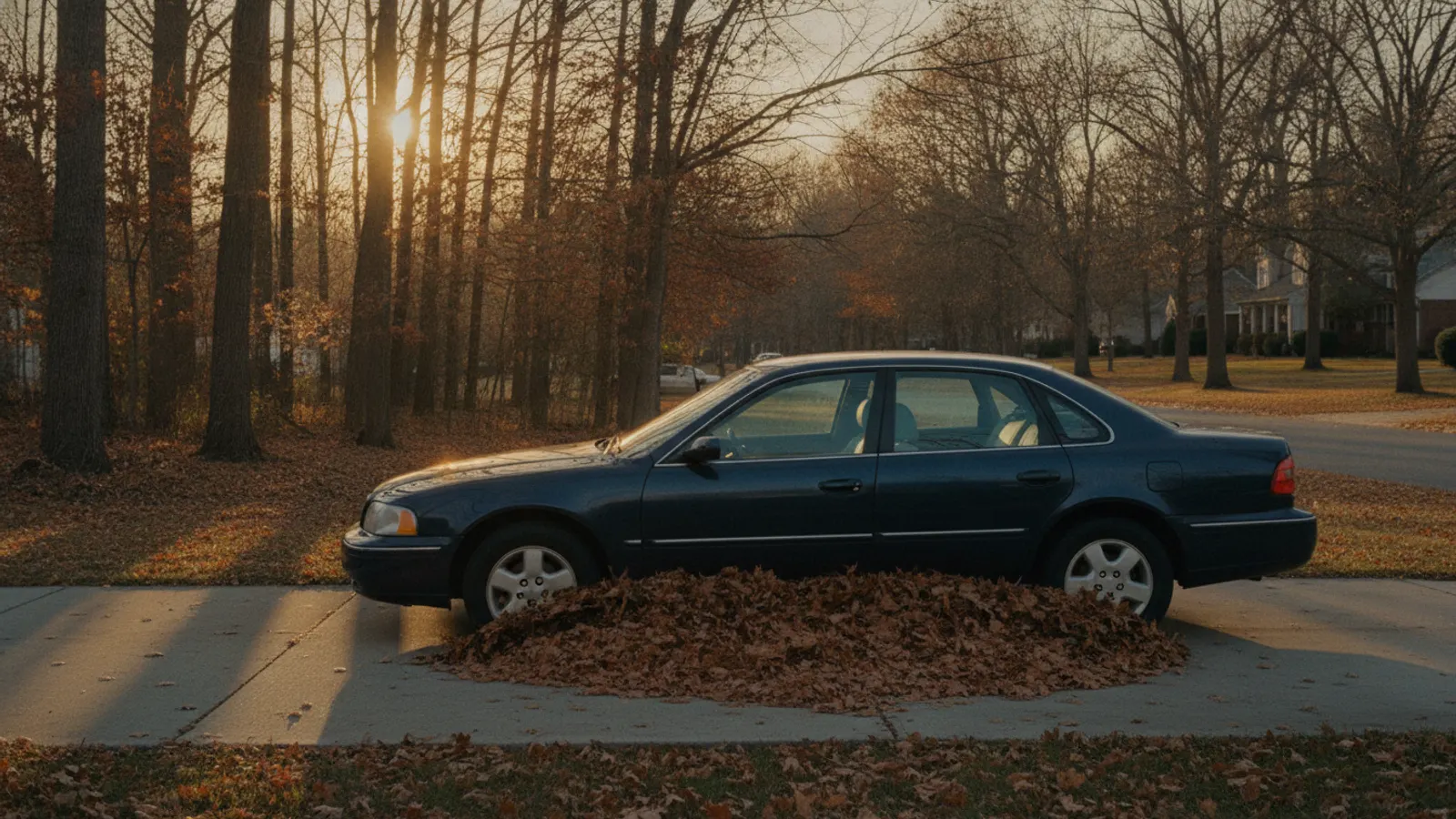
What each season asks of the car
Cold before snow, snow before the restriction, heat before the storms. The year in the order a car meets it, and why every part of the answer has to be bought out of season.
A car meets the year in the same order every time. The cold arrives before the snow. The snow arrives before anyone posts a restriction on the road. The heat arrives before the storms. None of it is a surprise, and almost none of the failure is a failure to know — it is a failure to have bought the thing in the month when it was still on the shelf.
What follows is the year rather than the car, each stage a condition rather than a date, because the dates belong to countries and the conditions travel.
Cold, before there is any snow
The first seasonal boundary has nothing to do with snow, and is easy to miss because the road still looks like the road. Transport Canada states that at temperatures below 7°C all-season and summer tyres begin to lose elasticity, leading to less traction. Spain’s traffic authority reaches the same number from a different climate, writing that when the thermometers drop below 7 degrees, summer tyres lose their qualities. Two road authorities, two continents, one threshold — and it is a temperature rather than a month, which is why a cold October morning in Ontario and a January in the Spanish interior are the same event for the same rubber.
Pressure crosses the boundary at the same time and in the same direction. Transport Canada’s sentence is the one to keep: a tyre that has good pressure when checked in a warm garage will be under-inflated when it is below zero outside, which is why the checks are done cold. Anyone relying on the dashboard to catch that is relying on the wrong instrument. The United States standard that put the warning light there, FMVSS No. 138, sets it to illuminate when pressure reaches 25 percent below the manufacturer’s recommended cold inflation pressure, or a value from the standard’s own table, whichever is higher. It is a floor alarm, and by the time it agrees with you a good deal of pressure has gone.
Snow, and the two ways a country can require you to be ready
There are two designs in use, and they fail for opposite reasons.
Québec runs a calendar. A vehicle must be winter-ready from 1 December to 15 March; the requirement covers all motor vehicles registered in Québec, including rental vehicles, and does not reach trailers or vehicles registered elsewhere. A compliant tyre carries the winter pictogram or is studded, and the province recommends at least 4.8 mm of depth for winter, a more demanding figure than the year-round legal floor. A calendar can be planned against; its weakness is that the weather does not read it.
Germany runs the condition instead. Under § 2 Absatz 3a of the Straßenverkehrs-Ordnung, a driver may drive in Glatteis, Schneeglätte, Schneematsch, Eisglätte or Reifglätte only if every wheel is fitted with tyres meeting § 36 Absatz 4 of the vehicle licensing regulation — tyres whose tread pattern, compound or construction improves starting, stabilising and braking on snow, and which carry the Alpine symbol, the mountain pictogram with a snowflake, under UNECE Regulation No 117. There is no date anywhere in it. The obligation begins when the ice does, which is the trap: a condition cannot be complied with retrospectively, and freezing rain does not wait at the edge of town while you find a fitter.
Spain sits between the two, telling drivers heading into forecast snow to have chains available or winter tyres fitted, to check the forecast and the road-condition service before setting out, and warning that it may restrict vehicles with neither.
The Alpine symbol is the common currency across all three. UN Regulation No 117 defines a tyre bearing it as a snow tyre for use in severe snow conditions and requires it to reach a minimum snow grip index against a standard reference test tyre. Spain’s DGT draws the distinction a buyer needs: M+S is a self-certification by the manufacturer, who checks his own product, whereas the three-peak mountain means the product passed a standardised external test at an approved laboratory and showed itself fit for use in snow without needing chains. Two marks on one sidewall, and only one was tested by somebody else.
Transport Canada adds the two instructions people economise on: fit winter tyres in sets of four to keep control and stability on ice, and do not use tyres worn close to 4 mm of tread depth on snow-covered roads. A pair on the driven axle is not half a set — it is a car that accelerates better than it steers.
When somebody closes the decision for you
Above a certain severity the choice stops being yours, and what you are carrying decides whether you pass. California’s chain controls are the clearest published example. At R-1 chains are required on all vehicles except passenger cars and light-duty trucks under 6,000 pounds fitted with snow tyres on at least two drive wheels, which must still carry chains. At R-2 the exception narrows to four-wheel and all-wheel-drive vehicles with snow-tread tyres on all four, which must carry traction devices in the control area. At R-3 they are required on all vehicles, no exceptions — and Caltrans adds the sentence that tells you what R-3 means: a highway will often be closed before an R-3 condition is imposed. Where chains are required the speed limit drops to 25 or 30 miles an hour, which is its own answer to anyone treating the equipment as a way of keeping to a schedule.
The cold that is not about grip
The rest of winter attacks fluids, glass and starting current, and Transport Canada’s preparation guidance is unusually specific about it: fill up on winter washer fluid in the -40°C range and carry an extra jug in the vehicle; make sure the motor is in good working order, because motors need a fully charged battery to start in cold weather; test the strength and level of the coolant and antifreeze, and make sure the heater and defroster work well. Summer-grade washer fluid in a reservoir at minus fifteen is not weak washer fluid. It is a block of ice in the one system you need most on a salted road, and it takes the pump with it.
Britain’s Highway Code adds the part that happens in the five minutes before departure and is routinely skipped: clear all snow and ice from all the windows, keep lights clean and number plates legible, clear the mirrors, demist the windows, and remove snow that might fall into the path of other road users. It also supplies the number that puts the section in proportion — on ice and snow, stopping distances can be ten times greater than on dry roads — and its blunter rule, not to drive in those conditions at all unless the journey is essential.
Heat, which does the same work more slowly
The hot half of the year is less dramatic and better at hiding. Spain’s traffic magazine puts the cooling system first, calling it fundamental to avoiding serious breakdowns caused by heat, and flags the mechanism most owners never look for: the evaporation of fluids at high temperatures, especially the coolant and the antifreeze. The battery, it says, suffers most from extreme temperatures, because the acid inside dries more easily when it is hot — the same part that failed in January, failing for the opposite reason. Tyres need to be in good condition and at the correct pressure to avoid blowouts, punctures and premature wear, and summer asphalt reaches temperatures that tell on the rubber over a long run. And the placard pressure is a cold pressure: a gauge read after an hour on hot asphalt shows more than the placard says while the tyre is still under-inflated.
The season with published dates
One season is defined administratively, which makes it the only one with a genuine deadline. The National Hurricane Center states that the Atlantic hurricane season runs from 1 June to 30 November, with its peak on 10 September and most activity between mid-August and mid-October, and that the eastern Pacific season runs from 15 May to 30 November. That is a procurement calendar rather than a forecast, published years in advance.
What the vehicle needs before it is not exotic: the same cooling system and tyres, a full tank, and a decision taken in advance about where the car goes when the water comes. The National Weather Service’s instruction for the road leaves no room to negotiate — do not drive into flooded roadways or around a barricade, which is somebody else’s finished assessment of a road you are looking at from one end.
The insurance half is separate and worth settling before a storm rather than after one. Whether water damage to a car is paid for at all turns on which cover was bought, not on how the water arrived, and that is a policy question this section answers elsewhere.
For a fleet, the season is a purchase order
Everything above becomes a scheduling problem the moment there is more than one vehicle. Québec’s obligation reaches rental vehicles, so a rental fleet changes over on a date fixed by law rather than by a manager. In California there is no exemption for heavy-duty commercial vehicles over 6,500 pounds fitted with snow tyres: chains go on the drive axle whenever chain controls are posted, and a towed trailer with brakes needs at least one axle chained, always.
The decision behind that is made months earlier, by somebody who will not be driving. Tyres have to be ordered, stored, and fitted by a finite number of people in a finite number of bays; chains have to exist in the right size for the axles in service, and be in the vehicle rather than the depot. A fleet that decides in November competes for the same fitters as every consumer in the region, at the price that competition produces.
What we cannot tell you
We cannot tell you when to change over, because the trigger two road authorities publish is an air temperature and nobody knows what yours will do. We cannot tell you what a winter tyre is worth in stopping distance on your road: the marking certifies a laboratory comparison against a reference tyre, not a metre count on the surface you will meet. And we cannot tell you what your policy pays for a flooded car, because that is written in the policy and not in the weather.
The month to do this is the wrong month
Book the changeover before the first cold snap, because the constraint is fitting capacity and not stock. Buy the washer fluid rated for the temperature you will actually see. Have the coolant tested rather than topped up, before each of the two extremes. Put the chains in the vehicle when you buy them, and check they fit the wheels currently on it.
The seasons are the part of a car’s year that is published in advance, and still the part bought for late.
Frequently asked questions
Are winter tyres about snow or about cold?
Both, and the cold arrives first. Transport Canada states that at temperatures below 7°C all-season and summer tyres begin to lose elasticity, leading to less traction, and Spain's DGT makes the same point at the same number, saying that when thermometers drop below 7 degrees summer tyres lose their qualities. That threshold is a temperature and not a date, which is why a mild winter month in southern Spain and a cold autumn morning in Ontario can be the same problem for the same rubber.
What does the three-peak mountain and snowflake symbol actually certify?
It is defined in UN Regulation No 117, which calls a tyre carrying it a snow tyre for use in severe snow conditions and requires it to reach a minimum snow grip index against a standard reference test tyre. Spain's DGT draws the contrast that matters for a buyer: M+S is a self-certification by the manufacturer, who checks his own product, while the three-peak mountain means the product has passed a standardised external test by an approved laboratory and has shown itself fit and safe for use in snow without needing chains.
If my car has a tyre-pressure warning light, do I still need to check pressures in winter?
Yes, because the light is a floor alarm and not a gauge. The United States standard that requires the system, FMVSS No. 138, sets the telltale to illuminate when pressure falls to 25 percent below the vehicle manufacturer's recommended cold inflation pressure, or a value in the standard's own table, whichever is higher. Transport Canada puts the seasonal half of it plainly: a tyre that has good pressure when checked in a warm garage will be under-inflated when it is below zero outside.
This guide explains how car insurance claims generally work. It is not legal advice, does not create a lawyer–client relationship, and is not a statement of any insurer's or regulator's position. Rules change and differ by jurisdiction; check the cited instrument and, where money or injury is at stake, consult a licensed professional in your jurisdiction.